Iconic ‘Hip’-ster: The Opel Rekord C Celebrates Its 60th Anniversary
Combined values for Opel Astra Electric and Astra Sports Tourer Electric according to WLTP1: energy consumption 15.3-15.8 kWh/100 km, CO2 emissions 0 g/km; CO2 label: A.
Combined values for Opel Astra Plug-in-Hybrid and Opel Astra Sports Tourer Plug-in-Hybrid according to WLTP1: Energy consumption weighted 12.6-13.0 kWh electricity/100 km plus 2.2-2.3 l petrol/100 km; CO2 emissions 49-53 g/km; CO2 label B. When the battery is discharged: fuel consumption 5.4-5.6 l/100 km; CO2 label D.
Combined values for Opel Astra Hybrid and Astra Sports Tourer Hybrid according to WLTP1: Fuel consumption 4.9-5.1 l/100 km, CO2 emissions 109-114 g/km; CO2 label: C.
Combined values for Opel Astra 1.5 Diesel and Astra Sports Tourer 1.5 Diesel according to WLTP1: Fuel consumption 4.9-5.1 l/100 km, CO2 emissions 130-134 g/km; CO2 label: D.
‘Feel the made in Germany.’ The campaign for the new Opel Astra demonstrates what modern German engineering is all about: emotional design, outstanding precision and uncompromising quality. The bestseller from Rüsselsheim embodies all these values and unites them with a high level of comfort and flexibility at affordable prices.
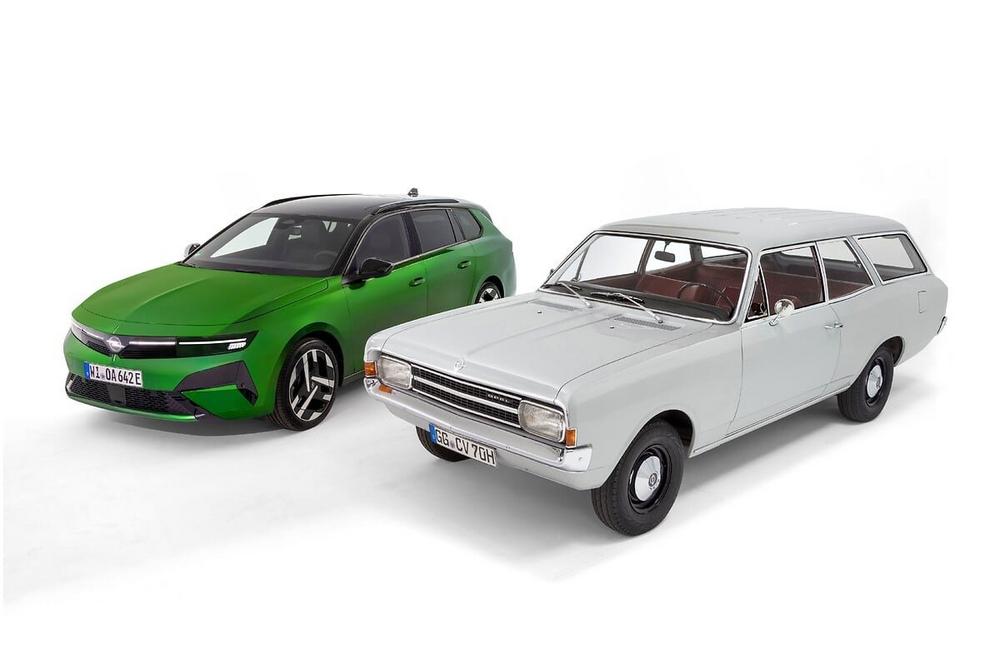
In the 1960s, the Opel Rekord was what the Astra is to many people today. In 1963, the Rekord A was launched as a mid-range model for everyone; the slightly revised Rekord B followed in 1965 with new engines. And just one year later – exactly 60 years ago – the manufacturer unveiled the Opel Rekord C. The third generation of the Rekord was almost a ‘reinvention’ of the model range. It was redesigned from the ground up, offered enhanced comfort and came with innovative features and body styles that made drivers’ dreams come true.
August 1966: The completely redesigned Opel Rekord C makes its debut
The Rekord C made its debut in August 1966. Right from the start, it stood out for its wide range of variants: as a two- and four-door saloon in standard and luxury versions, as well as a three- and five-door estate. In addition, there was a van and, a few months later, the star of the new model range, the fastback coupé.
Under the bonnet, four- and six-cylinder CIH (camshaft-in-head) engines powered the Rekord C. The range comprised eight engines, offering power outputs from 43 kW (58 hp) to 78 kW (106 hp) across capacities ranging from 1.5 litres to 2.2 litres. “The key to this remarkable breadth of choice,” said Opel’s management at the time, “is a single motive: to satisfy the individual wishes of everyone from the budget-conscious buyer to the very discerning customer.”
Technical innovations: Rekord C with front disc brakes and rear coil springs
Even the entry-level models boasted innovative features and safety elements that were anything but commonplace at the time. These included the Rekord C’s modern chassis: at the front, the track width was increased from 1,325 to 1,400 millimetres, whilst improved suspension damping enhanced both ride comfort and safety. The most significant changes, however, were found at the rear. Leaf springs were no longer used on the rear axle; instead coil springs came into play as well as double wishbones and a Panhard rod. This made the Rekord C the first Opel passenger car to feature coil springs on the rear axle. The anti-roll bars, which were standard at the front, were also optionally available at the rear.
Meanwhile, the Rekord set further benchmarks: it was the only vehicle in its class in which all variants were fitted with a dual-circuit braking system and brake booster facilitating rapid deceleration of the vehicle as standard. In addition to the increased length and width of the interior, features such as the new heating system enhanced passenger comfort; this system allowed “unheated or heated fresh air, as well as mixed air (temperature-controlled fresh air) to be fed into the car. The airflow then draws the stale interior air out through the rear air vents,” as it was described. A highly advanced system for its time.
Dreams come true: Fastback Coupé, Sprint, ‘Black Widow’ and Convertible
Whilst the delivery van and estate ensured that – as the contemporary advertising brochure put it – “bulky equipment and even Grandma’s garden furniture” could be accommodated in the spacious rear compartment, the design of the other body styles focused on dynamism.
The sporty, fastback-style Rekord Coupé introduced in the spring of 1967 initially served as the top-of-the-line model in the Rekord series. According to the designers from Rüsselsheim, this was “not simply a Rekord saloon with a sloping rear roof, but a sporty, sleek car with a character all of its own.” As the B-pillars on either side were missing, a sense of airy spaciousness was created. With its unmistakable lines, the ‘Coke bottle design’ typical of the Rekord further emphasised the Coupé’s dynamic appearance. A real ‘hip’-ster was born!
That very same year, Opel raised the bar further with the Rekord Sprint: already displaying its sporting credentials on the outside with its rally stripes and auxiliary headlights, the two-door model showed just what it was capable of with its 78 kW (106 hp) 1.9-litre four-cylinder engine: It accelerated from 0 to 100 km/h in 12.5 seconds, leaving most of the vehicles of that era in its wake.
The only ‘Rekord model’ to be even more powerful was the 1968 ‘Black Widow’, which remains legendary to this day. This was a Group 5 special touring car based on the Rekord 1900 S, built by the motorsport-enthusiast Opel designer Anatol Lapine and a few of his colleagues, without the official knowledge of Opel’s Board of Management. The engineers tuned the four-cylinder engine of the black two-door car with two twin carburettors to 132 kW (180 hp) – double the power of the production model. They also reinforced the powertrain and optimised the chassis. As early as its second race appearance in 1968 at the Hockenheimring, the car, with Erich Bitter at the wheel, set the fastest lap time despite strong competition from Porsche. But the Rekord C was also used to great effect in rallying, for example by the Swedish top driver Lille-Bror Nasenius, who finished as European vice-champion in the 1967 season.
The wide range of production models was rounded off by the exclusive four-seater Rekord Sport Cabriolet, which was built by the coachbuilder Karl Deutsch from Cologne. Furthermore, the Rekord C also served as the basis for the Opel Commodore A, which raised the bar for sporty saloons even higher from 1967 onwards. The Commodore bridged the gap between the Rekord and the flagship models Opel Kapitän and Opel Admiral.
A real bestseller: The Rekord C becomes the first ‘Opel millionaire’
With its design, versatility and innovative technologies, the Rekord C was a real bestseller. By the end of production in December 1971, more than 1.25 million Rekord C cars had rolled off the production line. The Rekord C became the brand’s first model to break the one-million mark and set a new record for Opel’s mid-range models.
Thus, from the late 1960s onwards, the Rekord C became the car that, to this day, symbolises freedom, friendship and holds many memories. ‘Die Toten Hosen’ have also paid it special tribute – twice. A Rekord C Caravan could be seen on the cover of their debut album, ‘Opel Gang’, released in 1983. So it was clear to the German cult punk rockers even in 2026 – 43 years later – that the same model just had to feature on the cover of their last regular studio album, ‘Trink aus! Wir müssen gehen’ (‘Drink up! We have to leave’). In this way, the circle is complete between Opel and the legendary punk rock band, who are on a major tour until September.
Responsible performance: The new Opel Astra and Astra Sports Tourer
Performance and emotional design – these are the qualities that define today’s Opel Astra compact-class bestseller. At the same time, Astra and Astra Sports Tourer with their length of 4.37 and 4.64 metres closely match the dimensions of the former Rekord mid-size model. Behind the clear, dynamic lines is an interior concept that makes no compromises. With a loading area of over one metre in length and width and up to 1,634 litres of luggage compartment volume, today’s estate offers plenty of space for everything that accompanies everyday life.
Safety and comfort remain top priorities for Opel. With the latest-generation adaptive, glare-free Intelli-Lux HD light – with over 50,000 pixels and dynamic light animations – Opel is redefining standards in the compact class. This is complemented by standard Intelli-Seats, which are characterised by a special recess running in the middle of the seat, reducing pressure on the tailbone and further enhancing comfort.
In addition, the new Opel Astra is crisper, bolder and more resource-efficient than ever. The new Astra Electric, for example, now enables up to 454 kilometres (according to WLTP2) between individual charging stops. The same applies to the plug-in hybrid. The drivetrain has also been further developed so that the purely electric and thus locally emissions-free range could be increased. Both drives are part of the comprehensive range of powertrains, which also offers customers a choice of efficient hybrid and diesel alternatives – tailor-made for all needs and every application.
[1] A vehicle’s values not only depend on the vehicle’s efficient use of fuel but are also influenced by driving behaviour and other non-technical factors.
[2] The stated range was determined on the basis of the WLTP test procedures (Regulation (EC) No. 715/2007 and Regulation (EU) No. 2017/1151). The actual range may vary under everyday conditions and depends on various factors, in particular personal driving style, route conditions, outside temperature, use of heating and air conditioning as well as thermal preconditioning.
Opel Automobile GmbH
Bahnhofsplatz 1
65423 Rüsselsheim
Telefon: +49 (6142) 7-70
Telefax: +49 (6142) 77-8409
http://de-media.opel.com/de
