Increased Precision, Flexibility and more detailed Information: The development of Dynamic Image Analysis
Sharper Contours, Finer Details
Out of focus particles and insufficient depth of field can noticeably compromise the quality of dynamic image analysis. QICPIC/S addresses both challenges directly: a higher resolution with smaller pixels delivers exceptional detail accuracy, while increased illumination intensity effectively prevents motion blur. The result is razor-sharp particle contours, which are essential for precise shape parameters, especially where the shape plays an important role in its final properties. At the same time, the finest measuring usable measuring range is extended further downward. Even the finest fractions can now be quantified, rather than disappearing into optical noise. This is a relevant aspect for applications involving active pharmaceutical ingredients or lactose, as well as for quality control of the finest particles in many other industries.
More Particles, More Meaningful Data
The number of particles captured is another key factor in the statistical reliability of particle measurements. The QICPIC/S addresses this issue by offering a significantly higher frame rate than previous models: combined with a larger field of view, it captures a substantially greater number of particles within the same measurement time, translating directly into higher statistical confidence, improved repeatability, and more stable results. For samples where material is limited, this can be a practical advantage since meaningful results tend to require less sample material. The higher particle count also enables the detection of occasional outliers, such as agglomerates or extremely fine abrasion particles, more reliably.
Flexible Measurements, Application-specific
The measuring range, frame rate, and resolution can be flexibly combined in the software, allowing QICPIC/S to operate in different modes depending on the application. Combined with newly developed lenses, the high-resolution camera doubles the dynamic particle size range that can be captured during a measurement. This automatically extends the usable analysis range, offering clear benefits to both single- and multi-range users. Whilst the former benefit directly from a broader measurement spectrum, extremely broad distributions can be captured using fewer optical modules.
The system is further enhanced by a new segmentation algorithm that enables even more precise detection of particles with the sharpest possible contours. Particles that are closely adjacent or touching can be separated from one another more reliably. This is particularly beneficial for challenging samples, where identifying individual particles in captured images can be difficult.
. Thanks to full backwards compatibility, users who wish to continue using existing methods can do so without needing to revalidate them.
QUIXEL | Proven Dispersion Technology, Now Available for Dynamic Image Analysis
The quality of a sensor is only ever as good as the sample preparation feeding it. QICPIC/S continues the modular concept of previous QICPIC systems. Depending on the sample and measurement task, the sensor can be combined with different feeding and dispersion systems for dry and wet applications.
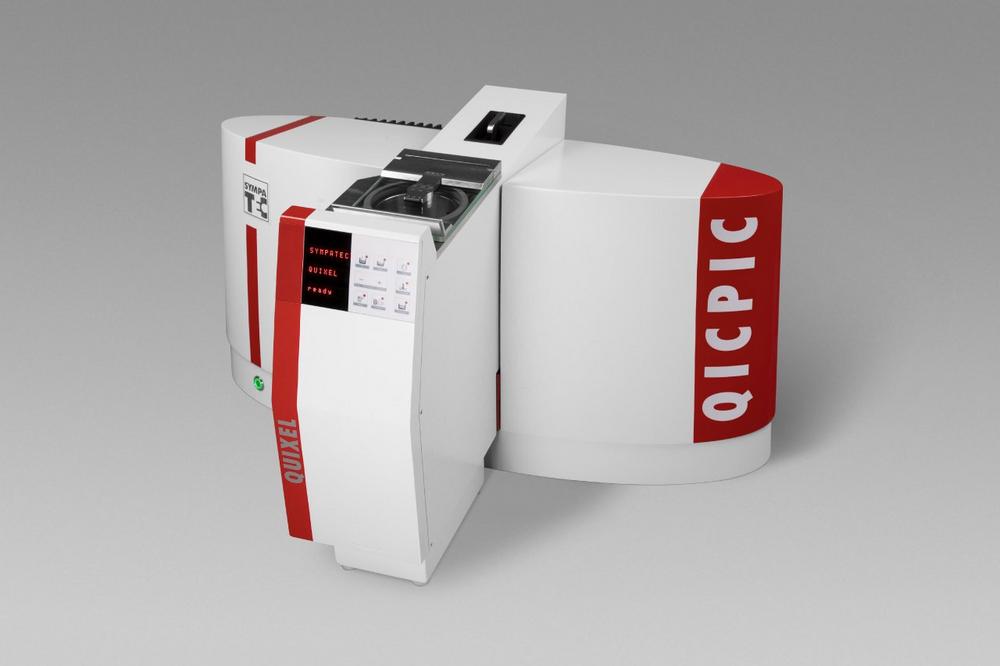
At the fair, Sympatec will be showcasing the proven wet dispersion unit, which reliably disperses both fine and coarse particles in suspensions and emulsions. Previously used exclusively for laser diffraction, the QUIXEL is now available for the first time in a version specifically developed for the new QICPIC/S. While the technology, functionality and components remain the same as in the established system, the new version offers precise integration into the current sensor generation. This includes a real-time display of optical concentration, giving operators full control while loading the sample.
Thanks to the system’s design, even demanding, high-density samples are safely transported in liquid through the flow cuvette. An integrated ultrasonic unit supports the dispersion process, while a generously sized water reservoir ensures robust operation. Although operation is fully automated, it can be switched to manual control via the control panel at any time. A well-thought-out maintenance concept featuring easily accessible components and a lowering bottom basin makes cleaning simple and allows for quick draining in seconds.
Experience It Live at POWTECH 2026
With QICPIC/S, Sympatec continues the development of its established technology for dynamic image analysis. Proven principles such as modular, product-appropriate dispersion and single-particle analysis are combined with a new generation of camera technology, optics and image analysis.
Visitors are invited to experience these innovations in action by bringing their own samples to Booth 7-807 in Hall 7. The Sympatec team will be presenting QICPIC/S and QUIXEL live and will be on hand to answer questions about methods and applications.
For further information on Sympatec’s range of instruments, please visit www.sympatec.com.
Die Sympatec GmbH wurde 1984 als Spin-off der Technischen Universität Clausthal gegründet und überzeugt seit über 40 Jahren mit Hightech-Instrumenten für die Analyse von Partikelgröße und Partikelform als global agierender Pionier für Anwendungen in Labor und Prozess. Mit kontinuierlichen Innovationen in den Technologiefeldern Laserbeugung, Bildanalyse, Ultraschallextinktion und dynamischer Lichtstreuung (DLS) leisten wir einen markanten Beitrag zur Entwicklung, Produktion und Qualitätskontrolle auch anspruchsvollster disperser Partikelsysteme z.B. in Pharma, Food, Chemie, Bau-/Grundstoffen, Pulvermetallurgie. Sympatec ist mit rund 180 Beschäftigten an 20 Standorten und mit Partnern in über 70 Ländern vertreten.
Sympatec GmbH System-Partikel-Technik
Am Pulverhaus 1
38678 Clausthal-Zellerfeld
Telefon: +49 (5323) 717-0
Telefax: +49 (5323) 717-229
http://www.sympatec.com
