Ensuring the successful launch of the hydrogen economy
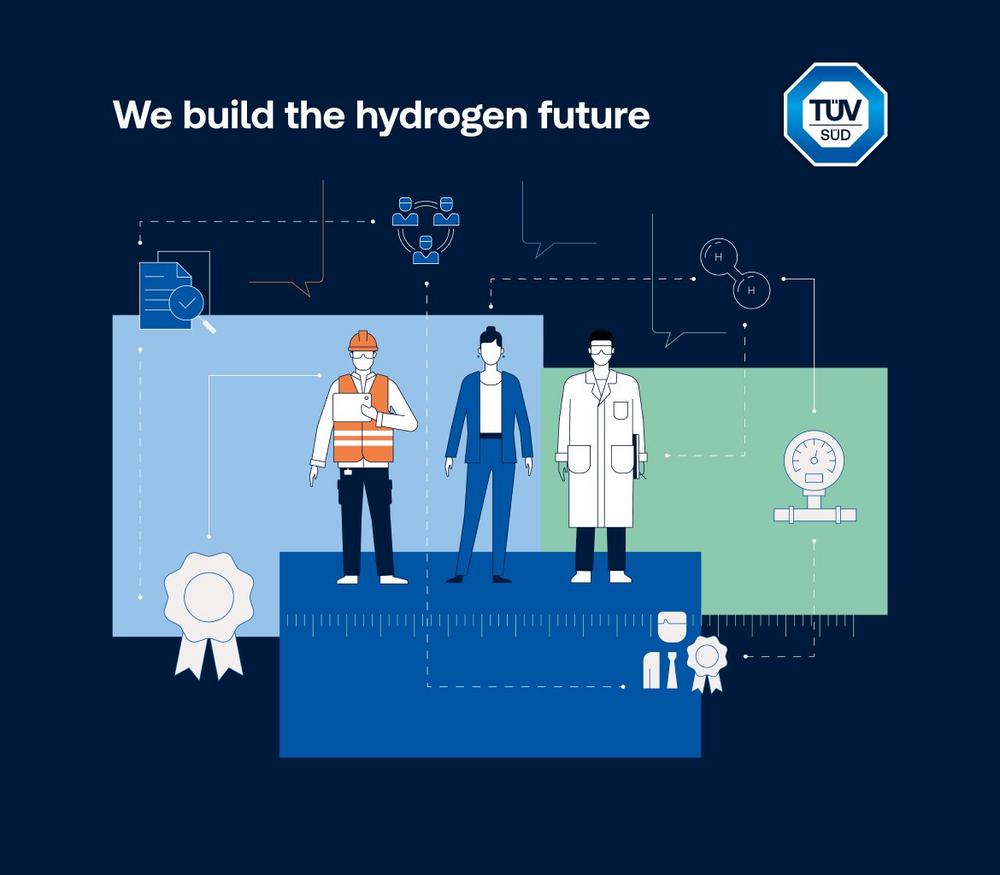
Green hydrogen can make a significant contribution to the energy transition. However, for it to be used safely in industrial applications, materials, components and plant must be able to handle hydrogen reliably. TÜV SÜD supports manufacturers and operators in demonstrating the necessary safety, durability and performance of their solutions. The scope ranges from material analyses and pressure tests, through functional and endurance tests, to the testing of complete systems.
With its new hydrogen testing laboratory in Garching, TÜV SÜD has further expanded its capabilities for testing hydrogen components and systems. The focus is on testing under realistic conditions. This enables, amongst other things, pressure cycles of at least 150 MPa and tests within a temperature range of -40 °C to +180 °C. A hydrogen pressure cycler with automatic leakage and cycle monitoring enables accelerated service life testing and supports the development and qualification of components for use with hydrogen.
Early qualification for hydrogen
With its H2 Readiness certification, TÜV SÜD supports manufacturers and operators in demonstrating the suitability of their products and systems for future hydrogen operation at an early stage. Test standards such as P003 and P005, developed in collaboration with manufacturers, provide a basis for assessing materials and components in terms of their durability and functionality under hydrogen conditions.
In addition, specific guidelines – for example, for gas and steam turbine power stations and engine power stations – provide guidance for the gradual transition to hydrogen. This enables operators to assess the technical requirements at an early stage, plan investments more effectively and prepare for future hydrogen operation. In addition, voluntary certification programmes based on international standards, including IEC 62282, ISO 19880-X and ISO 19887, ensure greater transparency throughout the hydrogen value chain.
Testing under real operating conditions
Due to its physical and chemical properties, hydrogen places particular demands on materials and components. TÜV SÜD offers testing for various pressure and temperature ranges, as well as for hydrogen, helium and gas mixtures. The range of services includes functional and endurance tests, hydraulic burst tests, gas flow tests, and leakage and permeation tests on pressure vessels and other hydrogen-carrying components.
Another key focus is on investigating the hydrogen compatibility of metallic and non-metallic materials. This enables the analysis of potential effects such as hydrogen embrittlement, permeation or changes in material properties. The results of these investigations form an important basis for the safe design of components and systems.
Standards as the basis for safe products
Manufacturers of fuel cells, electrolysers and hydrogen-carrying components – for example, for vehicles or refuelling stations – can rely on TÜV SÜD’s testing and certification expertise. Products and systems are assessed against international standards and technical requirements. Relevant standards include, amongst others, IEC 62282 for fuel cells, ISO 22734 for electrolysers, ISO 19880-X for refuelling station components, ISO 19887 for vehicle components, and ISO 17268 for refuelling couplings and refuelling nipples.
The testing and certification services range from individual components to more complex hydrogen systems. This enables manufacturers to take relevant requirements into account as early as the development phase and lay the foundations for subsequent market authorisation.
Keeping an eye on regulatory requirements
For the successful deployment and distribution of hydrogen technologies, regulatory requirements must be taken into account alongside technical evidence. Among other things, the experts at TÜV SÜD support manufacturers in understanding relevant standards and regulations, as well as in preparing for CE marking or obtaining type approval.
The combination of testing, assessment and certification helps companies systematically meet technical requirements and qualify their products for their respective target markets.
TÜV SÜD’s international network also provides support in navigating the varying regulatory requirements across international markets.
Expertise for hydrogen applications
In addition to testing and certification services, qualified specialist staff are a key prerequisite for the safe ramp-up of the hydrogen economy. The TÜV SÜD Academy provides specialists in development, operation and maintenance with practical knowledge – ranging from the fundamentals of hydrogen technology to specific technical and regulatory issues.
The role-based qualification scheme covers various areas of the hydrogen value chain. These include, amongst others, electrolysis processes, storage and transport technologies, fuel cell applications, material compatibility, and risk and safety aspects. Regulatory topics such as declarations of conformity and the certification of green hydrogen are also part of the training programme.
The focus is always on the safe and professional use of hydrogen. In addition to standardised seminars, the TÜV SÜD Academy also offers bespoke training solutions tailored to the specific requirements of companies and their employees.
From testing to application
TÜV SÜD combines its expertise in the fields of testing, certification and qualification to provide comprehensive support to companies in the development and validation of hydrogen technologies. Services range from the testing of individual materials and components, through the qualification of components, to the assessment of complex systems. In this way, TÜV SÜD supports manufacturers and operators from the development and technical validation stages, through conformity assessment, right through to the safe and standards-compliant operation of their hydrogen solutions.
About Hydrogen Technology Expo Europe
The Hydrogen Technology Expo Europe is an international trade fair and conference for hydrogen and fuel cell technologies and the associated value chain. From 20 to 22 October 2026, technology providers, system integrators, manufacturers and users from all over the world will gather in Hamburg. The focus will be on, amongst other things, technologies for hydrogen production, storage, distribution and utilisation, as well as fuel cells, infrastructure, mobility and safety.
Further information on TÜV SÜD’s services in the field of hydrogen and fuel cell technologies, as well as on their training and further education programme, can be found at:
TÜV SÜD
Westendstraße 199
80686 München
Telefon: +49 (89) 5791-0
Telefax: +49 (89) 5791-1551
http://www.tuvsud.com/de
