Compliance Trap 2026
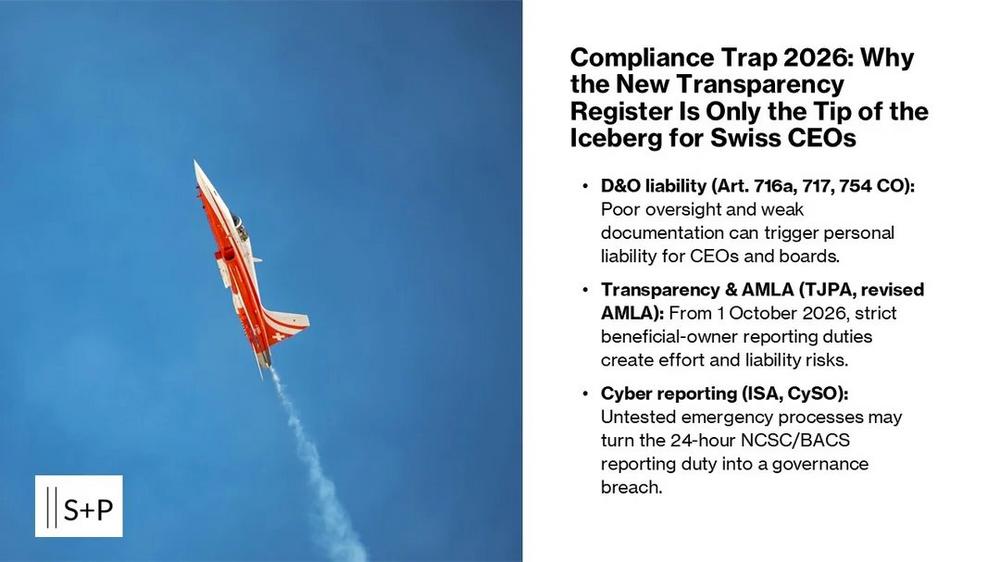
Why should CEOs read this article? Because by 2026, compliance will no longer be a back-office issue, but a personal liability risk. Transparency registers, supply chain obligations, chemicals legislation, cyber reporting requirements, and sanctions directly impact strategy, governance, and reputation. Those who fail to properly document responsibilities, evidence, and controls risk fines, directors‘ and officers‘ liability, and a loss of trust.
II. Time constraints, expired and upcoming deadlines
In 2026, Swiss CEOs must keep several deadlines in mind: ensuring ongoing sanctions screenings and cyber reporting processes, in particular the 24-hour reporting to the BACS for critical infrastructure. The consultation period for the NUFG (New Financial Markets Act) ends on July 9. Transparency registers and the revised AML Act (Anti-Money Laundering Act) come into effect on October 1. EUDR readiness for EU business transactions must be achieved by December 30. Chemicals Risk Reduction Ordinance (ChemRRV) obligations must also be reviewed on a product- and substance-specific basis.
III. Duties for C-level executives and compliance, including normative aspects
For Swiss CEOs, several specific compliance obligations with direct liability implications will arise in 2026. The focus is on the new transparency register under the Transparency and Justice Act (TJPG) and the revised Money Laundering Act, both of which will come into force on October 1, 2026. Companies must identify, verify, document, and keep up-to-date their beneficial owners. At the same time, KYC, risk, and control processes must be adapted.
In addition, there are obligations arising from existing and new sustainability, product, and cyber regimes. The draft Federal Act on Sustainable Corporate Governance increases the pressure to systematically record human rights and environmental risks along the value chain. The Chemicals Risk Reduction Ordinance requires testing for PFAS, microplastics, and other restricted substances. Operators of critical infrastructure must report notifiable cyberattacks to the BACS within 24 hours.
For internationally active companies, EU regulations also apply, in particular the EU Deforestation Regulation, which comes into effect on December 30, 2026, for affected EU business activities. CEOs should not treat these obligations as a departmental issue, but rather as a governance task: defining responsibilities, documenting controls, establishing escalation procedures, and ensuring auditable documentation.
The most important regulatory references are: the TJPG and the revised GwG from 1 October 2026 for transparency registers, beneficial owners and money laundering prevention; the Information Security Act / BACS reporting obligation for cyberattacks on critical infrastructures; the ChemRRV for PFAS, microplastics and substance restrictions; the NUFG draft on sustainable corporate management; and the EU Deforestation Regulation , insofar as Swiss companies place, trade or export products in the EU.
IV. Problem areas within the scope of the obligations to be implemented
1.) Organizational and supervisory liability:
Art. 716a OR: non-transferable duties of the board of directors, in particular overall management, organization, financial control and overall supervision.
Art. 717 OR: Duty of care and loyalty.
Article 754 of the Swiss Code of Obligations (OR): Liability for intentional or negligent breach of duty. These provisions form the core of personal liability for corporate officers in Switzerland.
2.) Transparency Register / Beneficial Owners:
TJPG, in particular obligations to identify, verify and report beneficial owners. The law enters into force on October 1, 2026 and applies to legal entities under Swiss private law as well as certain foreign legal entities and trusts.
3.) Money laundering / KYC:
The German Money Laundering Act (GwG) and revised anti-money laundering regulations: The scope of application is being extended to certain advisory services, such as those related to real estate transactions and the formation or structuring of legal entities. This increases liability risks in cases of incomplete identification, risk analysis, or documentation.
4.) Cyber reporting obligation:
Information Security Act (ISG) and Cybersecurity Ordinance (CSV): Operators of critical infrastructure must report cyberattacks to the BACS within 24 hours of discovery. For CEOs, the risk here lies in the lack of an incident response and escalation process.
5.) Product and fabric compliance:
ChemRRV, SR 814.81: The revision concerns, among other things, PFAS and microplastics. Liability risks arise in the case of untested materials, incorrect supplier declarations, sales stoppages, recalls, or regulatory proceedings.
6.) Sanctions compliance:
Embargo Act (EmbG) and the sanctions ordinances based on it: Switzerland implements international sanctions; companies must check business partners, ownership structures, payments, and flows of goods. Violations can have serious criminal and reputational consequences.
7.) ESG / Greenwashing / Sustainability:
Article 3, paragraph 1, letter x of the Unfair Competition Act (UWG) is relevant for climate-related statements: Climate impact claims must be objectively and verifiably substantiated. Additionally, the draft Environmental Impact Assessment Act (NUFG) is politically relevant, but not yet legally binding; therefore, it is better formulated as a "preparatory obligation from a governance perspective," not as an already existing legal obligation.
8.) EU business / Deforestation:
EUDR, Regulation (EU) 2023/1115, in particular Articles 3, 4 and 8: Affected products may only be made available on the EU market or exported if they are deforestation-free, legally produced and covered by a due diligence declaration. Applies from 30 December 2026 to many companies with EU ties.
V. Implementation roadmap and solution recommendations
The most important solution for CEOs in 2026 is: Compliance must be demonstrably managed. This means prioritizing risks, assigning responsibilities in writing, documenting controls, and testing escalation procedures. With regard to Articles 716a, 717, and 754 of the Swiss Code of Obligations (OR), the board of directors and management should be able to demonstrate that transparency registers, anti-money laundering/Know Your Customer (KYC) regulations, cyber reporting obligations, the Chemical Risk Reduction Ordinance (ChemRRV), sanctions, and ESG risks are actively monitored. A robust compliance dashboard with deadlines, owners, audit status, and measures taken is crucial.
In short: CEOs in 2026 should not accumulate even more individual measures, but rather create a system that demonstrates: risks have been identified, responsibilities clarified, controls implemented, and the board of directors informed. This is the most effective defense against personal liability.
VI. Conclusion
For Swiss CEOs, compliance will become a personal leadership responsibility by 2026. Transparency registers, the Anti-Money Laundering Act (AML), cyber reporting obligations, the Chemicals Risk Reduction Ordinance (ChemRRV), sanctions, and ESG risks demand clear responsibilities, robust controls, and auditable documentation. The crucial factor is not whether compliance has been delegated, but whether the board of directors and management have effectively monitored compliance in accordance with Articles 716a, 717, and 754 of the Swiss Code of Obligations (OR).
S+P Unternehmerforum GmbH mit Sitz in München ist ein führender Anbieter für praxisnahe, rollenbasierte Weiterbildung im deutschsprachigen Raum. Seit der Gründung im Jahr 2004 unterstützt S+P Fach- und Führungskräfte sowie C-Level-Manager:innen aus der Finanzwirtschaft und Industrie dabei, sich gezielt weiterzuentwickeln und regulatorisch sowie strategisch sicher zu handeln.
S+P bietet ein breites Portfolio an Online-Seminaren, E-Learnings, Zertifikatslehrgängen und Executive Education Programmen. Themenschwerpunkte sind unter anderem Compliance, Geldwäscheprävention, Risikomanagement, Projektmanagement, Finance, Leadership und digitale Transformation.
Ein Alleinstellungsmerkmal ist die S+P Tool Box – mit sofort einsetzbaren Arbeitshilfen wie Leitfäden, Checklisten, Gantt-Plänen und Risikochecks. Zusätzlich steht allen Teilnehmer:innen die digitale Lernplattform S+P Lounge zur Verfügung.
Mit dem Zertifikat S+P Certified und dem digitalen Karriere-Badge dokumentieren Absolvent:innen ihre Kompetenz sichtbar – für Arbeitgeber, Kunden und Netzwerke.
Teilnehmer bewerten S+P Seminare auf ProvenExpert mit 4,65 von 5 Sternen. Für jedes gebuchte Seminar pflanzt S+P im Rahmen des ESG-Projekts „Dein Seminar, dein Baum, deine Zukunft“ einen Baum in Deutschland.
Mehr Informationen unter: www.sp-unternehmerforum.de
S&P Unternehmerforum GmbH
Feringastr. 12 A
85774 Unterföhring bei München
Telefon: +49 (89) 45242970100
Telefax: +49 (89) 45242970299
http://www.sp-unternehmerforum.de
