Trenchless main grid construction using HDD technology on major power highway
A-Nord supplies electricity to 2 million people
The A-Nord DC underground cable route is 300 kilometres long in total and starts in northern Germany (Emden-Petkum). There, wind energy is captured from the North Sea and converted into direct current by the converter for transmission southwards. The route ends in Osterath-Meerbusch, North Rhine-Westphalia, where a second converter transforms the direct current back into alternating current for feeding into the 380-kV distribution grid. The total transmission capacity is 2,000 megawatts. This corresponds to the electricity needs of around two million people.
Construction of A-Nord began in October 2023, with commissioning planned for 2027. The underground cable route consists of two systems, each of which comprises two 380-kV high-voltage cables and a return conductor. These are installed in parallel in two separate trenches. Where open-cut construction is not possible, for example when crossing existing infrastructure or when nature conservation requires it, the closed construction method is used. This is also the case for the section in central Germany, which runs for over 60 km to the converter.
Trenchless construction for route development
For the past two years, Niks Infra B.V. has been working on A-Nord construction sites, consistently relying on trenchless technology – more specifically, horizontal directional drilling (HDD). When building main grids, the closed construction method primarily reduces large-scale disruption to valuable surfaces, such as meadows and fields by avoiding the need for large amounts of excavated soil for cable trenches while also reducing CO? emissions, noise and dust caused by construction work. The HDD method is ideally suited for installing pipes along flexible routes due to the steerability of the drilling process. This allows pipes to be installed beneath existing infrastructure, roads and bodies of water, for example. A transmitter in the drill head enables the bore path to be continuously monitored by a locating system and corrected if necessary.
HDD drilling rig for long-distance efficiency
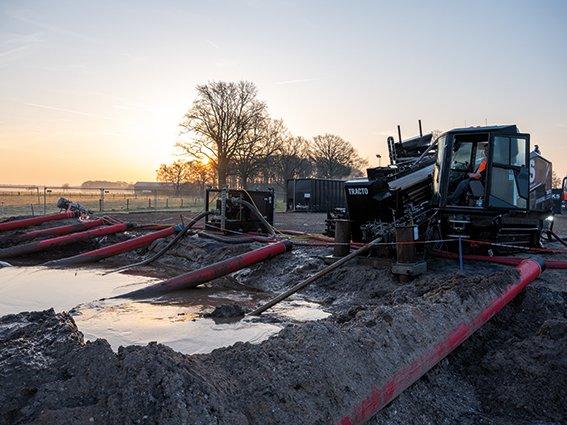
In the Geldern region, the A-Nord route crosses, amongst other watercourses, the Issumer Fleuth in the Fleuthkuhlen nature reserve. There, Niks Infra – which specialises in infrastructure projects – is using an HDD drilling rig specifically designed for route construction: the GRUNDODRILL JCS300 from manufacturer TRACTO. With 300 kN of thrust and pulling force and high torque, the JCS300 jet drilling rig has sufficient power to install large protective pipes over long distances.
For long, repeatable bores, such as those required in constructing main grids, the JCS300 is equipped with a particularly large supply of drill rods. The magazine holds 70 drill rods, each 4.5 m long, and up to six further rods can be reloaded simultaneously. The reduced number of rod joints compared to 3-metre rods, combined with a handling system in full-auto mode, enables faster drilling operations. Standard assistance systems also ensure efficient operation of the JCS300. Automatic drilling data recording, for example, simplifies precise documentation, which is a particular advantage for complex infrastructure projects with stringent documentation requirements, such as main grid construction.
The GRUNDODRILL JCS300’s high level of automation also makes operating the drilling rig highly efficient and guarantees precise drilling. Using a mobile HMI, the operator controls all processes via a central display in the cabin, which can also be used as a remote control. In addition to the machine and drilling data, the position data of the drill head – which is continuously recorded during pilot drilling by means of a walk-over locating system – is also displayed on the operating panel. This integration of the drilling rig and detection technology makes the precise control of the drill head even more accurate and further enhances the safety of the HDD process.
It was precisely these features of the JCS300 that convinced Niks Infra. For contractors such as Niks, they mean faster drilling, predictable workflows and the cost-effective implementation of challenging infrastructure projects such as with A-Nord. This is evident in practice: on the construction site in Geldern, the six 490-metre-long pilot bores along the cable routes were completed in an average of just seven hours. An expander for the individual bores to increase the diameter to the diameter of the pipes to be pulled through took a further working day in each case. A so-called ‘clean-up run’ to flush out the borehole, as well as the subsequent pulling-in of the cable protective pipes with diameters of 315 mm and 350 mm, also took just one day per pipe. The power cables will be pulled into the protection pipes at a later date.
NO-DIG is more than an alternative
Grid operator Amprion is also using trenchless technology for other routes: A-Nord will be bundled with two offshore grid connection systems, DolWin4 and BorWin4, over a length of around 100 kilometres. These systems carry electricity from wind farms in the North Sea to the North German mainland via the East Frisian island of Norderney, passing beneath it in the process. Installing the cables in the sensitive coastal landscape on the island was only possible using the enclosed construction method, also employing HDD. Six bores were drilled from the centre of the island towards the southern mudflats and the mainland over the summer; in 2026, drilling will continue from there towards the offshore converter platforms. To enable the bores to be started in the unstable sandy soil, another trenchless method was employed: ramming technology was used to drive casing pipes into the ground at the bores’ entry points to guide the way into the drillable layers.
Amprion’s use of trenchless technology on its power highways shows that NO-DIG methods in main grid construction are now much more than just an environmentally friendly alternative to open-cut construction. They are a crucial component in the cost-effective implementation of challenging infrastructure projects in compliance with regulatory requirements and with a high level of public acceptance. Contractors now have access to NO-DIG solutions that meet the installation quality, safety and cost-effectiveness requirements of high-performance direct-current transmission lines.
TRACTO
Paul-Schmidt-Straße 2
57368 Lennestadt
Telefon: +49 (2723) 808-0
Telefax: +49 (2723) 808-180
https://www.tracto.com
