A Hub for the Future of AI
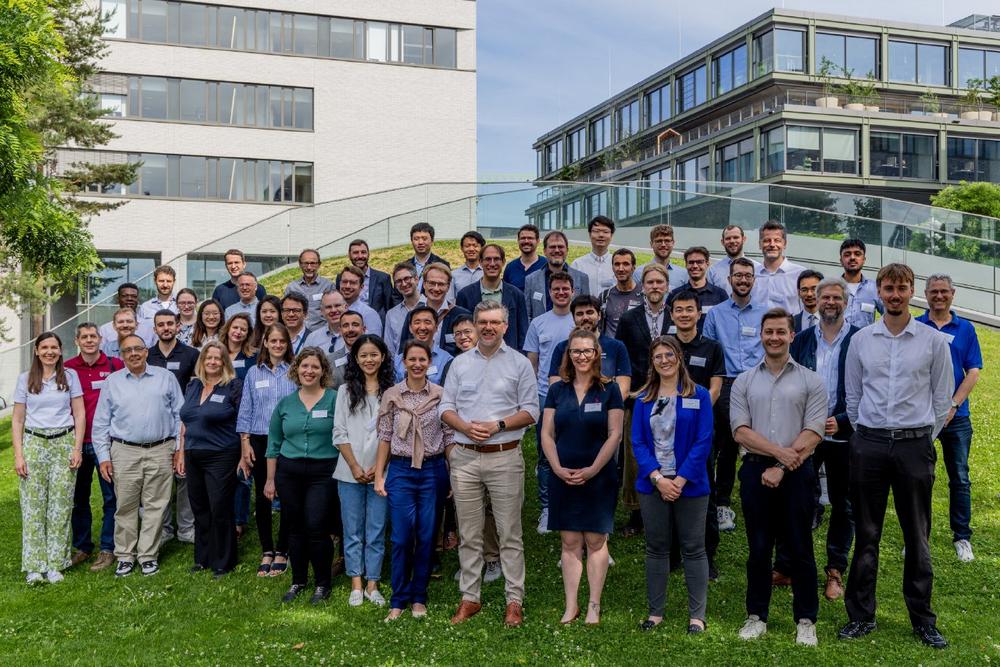
Prof. Ali Sunyaev, Vice President TUM Campus Heilbronn, summarizes the GTF’s core message: “This forum is based on collaboration: scientific dialogue, practical insights, and new networks pave the way for sustainable innovation.” It was with this in mind that the “Joint Global AI Research Hub” was launched.
Host Ali Sunyaev sums up, what sets the Global Technology Forum apart and what it aims to achieve in the future: “Joint papers. Shared datasets. Collaborative research proposals. Comparative studies. Co-supervised doctoral projects. Research that genuinely emerges from this community. Because the intellectual concentration in this room is extraordinary.”
In this research hub, the leading universities ETH Zurich, Hebrew University of Jerusalem (HUJI), HEC Paris, Nanyang Technological University (NTU), National University of Singapore (NUS), Stanford University, and the University of Oxford are working together with TUM Campus Heilbronn to develop solutions for the major challenges of our time. At the heart of the GTF are exchanges with regional and national companies and workshops where new research approaches and collaborations emerge.
GTF Meets TECH
As part of this year’s Global Technology Forum, the international guests visited TECH2026 at the ‘Theresienwiese’ exhibition grounds in Heilbronn to experience the local ecosystem firsthand and engage with companys. During the event, some of the researchers and professors participated as panelists in two discussion sessions..
At the House of Startups, the focus was on the ideal connection between research and application—and on ways to bridge the gap between the two. This very challenge was the focus of the public fishbowl discussion “Bridging the Gap Between Research and Its Application, Commercialization, and Spin-offs,” moderated by Prof. Martin Meißner from TUM Campus Heilbronn.
The panel featured international perspectives and bridge-builders, including Prof. Luise Pufahl from TUM Campus Heilbronn, Prof. Alexander Ling Euk Jin from the National University of Singapore, Prof. Rainer Dumke from Nanyang Technological University Singapore, and Dr. Joba Adisa from Stanford University. The experts identified the building blocks for this as including long-term, trusting relationships and the identification of market niches, which are also emerging due to the great future potential of quantum technology.
The TECH panel “Convergence or Collision: Bridging AI, Science & Society” also addressed the question of how scientific innovations can be successfully integrated into society. Moderated by Solveig Gode, Head of Podcasts, Live, and Video at Handelsblatt, the panel featured Prof. Tomer Shadmy from the Hebrew University of Jerusalem, Prof. Carl Benedikt Frey from the Oxford Internet Institute, Prof. Ali Sunyaev, Vice President TUM Campus Heilbronn, and Prof. Michael Impink from HEC Paris discussed how AI can be advanced for the common good of science and how the gap between scientific possibilities and societal readiness can be bridged.
While Tomer Shadmy focused on the question of where this development is headed and how institutions need to be reimagined, Carl Benedikt Frey argued for pushing boundaries and taking more risks in order to actively shape change. Ali Sunyaev highlighted the importance of knowledge sharing and international cooperation. Michael Impink emphasized that startups and society also benefit from innovation when there is a functioning market for ideas.
Workshops with Impact
A particular highlight of the forum is the workshops organized by the Joint Global AI Research Hub. On the second day of the GTF, the focus was on academic exchange among the Hub’s universities of excellence. This gave rise to new research approaches and international collaborations.
This year’s topics showcase the wide range of current issues influencing the future:
In the workshop “Reimagining Academia in the Age of AI,” Prof. Tomer Shadmy (Hebrew University of Jerusalem) discussed the future of universities and higher education institutions in the age of artificial intelligence with the participants. The discussion focused on the profound changes brought about by AI as a so-called general-purpose technology, as well as the question of how universities can rethink research, teaching, and social responsibility. The working groups developed perspectives for a stronger orientation of research toward analysis and implementation, for teaching with a focus on wisdom and competence development, and for the promotion of AI literacy as a central societal task for universities.
In the workshop “AI in Healthcare and Medicine,” Prof. Jingui Xie (TUM Campus Heilbronn) demonstrated how artificial intelligence can transform healthcare and medicine. Participants discussed the use of AI across medical workflows, the training of Large Language Models (LLMs) for clinical use, building trust in AI systems, and the challenges of transferring models to real-world application scenarios, particularly in the interaction between humans and AI. As a result, approaches for the joint redesign of medical processes were developed, and potential was identified, particularly for applications in the field of mental health.
In the workshop “AI and the Transformation of Work and Business Processes,” Prof. Luise Pufahl (TUM Campus Heilbronn) and Dr. Fabian Braesemann (University of Oxford) examined the impact of AI on work, productivity, and business processes. The focus was on developing relevant research questions, potential paths of transformation, and the opportunities and challenges for knowledge-intensive activities. The discussions led to the conception of an academic “discussion paper” intended to further explore the perspectives developed.
In the workshop “Advances in the Quantum Internet,” Prof. Alexander Ling Euk Jin (National University of Singapore) and Prof. Achim Kempf (University of Waterloo) provided insights into current developments in quantum communication and the quantum internet. Discussions centered on technological challenges in connecting devices and components over long distances, as well as the integration with AI. The participants agreed that quantum technology cannot be viewed in isolation, that it will not completely replace classical computers, and that, over time, certain standards will naturally emerge from the multitude of current systems.
More Than Just a Conference
As a panelist and workshop leader, Prof. Tomer Shadmy was one of the driving forces behind this year’s forum. This was her second time participating in the GTF, and she has a positive take on the event: “I like the big ambitions in Heilbronn because I’m someone who loves to think big. This ambition is to create a meeting space for the world’s best institutions and to think about the future of technology. The motivation to bring people together and do things differently from the usual academic conferences is great, and it creates a special spirit and outcomes.”
The GTF highlights Heilbronn’s role as an emerging ecosystem for innovation. When international expertise is combined, researchers exchange ideas across disciplines, and network with potential industry partners, joint projects emerge with an impact far beyond the region. They can drive the development of artificial intelligence while simultaneously addressing societal challenges. In this way, the future is actively developed, because as many participants emphasize: AI is here to stay.
Die TUM Campus Heilbronn gGmbH
Bildungscampus 2
74076 Heilbronn
Telefon: +49 (0) 7131 264180
Telefax: +49 (7131) 645636-27
https://www.chn.tum.de/de
