Arnold NextG Blogspot: Scaling Requires System Architecture
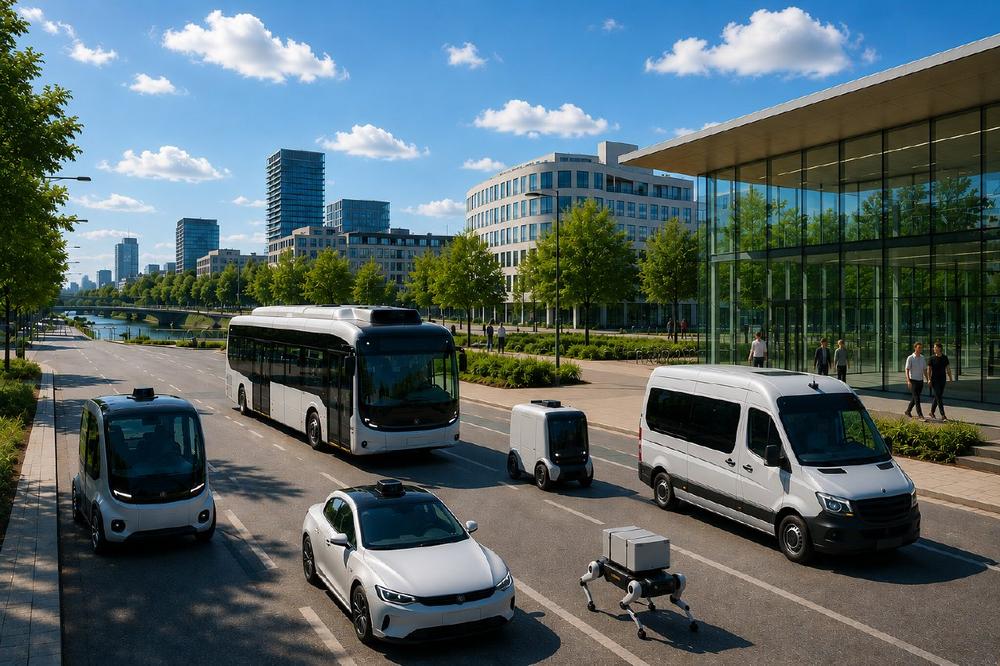
The discussion about autonomous mobility often focuses on driving functions, sensor technology, software, or approval processes. But the closer autonomous systems get to regular operation, the clearer another challenge becomes: the scalability of the underlying system architecture. Because the real question is no longer whether a single vehicle can drive autonomously. The decisive factor is whether control can be organized consistently, safely, and manageably across different vehicle platforms.
When scaling becomes an architectural issue
In pilot operations, many challenges can still be managed thanks to limited operating areas, clearly defined scenarios, additional intervention options, and manageable integrations. However, as scaling increases, this starting point changes fundamentally.
New vehicle types, different manufacturers, varying operating conditions, and growing fleets not only increase complexity. They also raise the bar for consistency in vehicle behavior and system control. This is precisely where many current approaches reach their limits.
This is because, in many vehicle architectures, motion control remains closely tied to individual platforms, integrations, or vehicle-specific logic. With each new platform come additional interfaces, new validation efforts, and potentially new system behavior. What initially appears to be a technical detail quickly evolves into a central operational challenge. After all, public mobility needs one thing above all else: predictability.
Passengers, operators, and public authorities do not expect a technology demonstration. They expect a system that behaves consistently in everyday use—regardless of which vehicle type is currently in service.
From the Vehicle to the System Level
As the scale grows, the perspective shifts. Control can no longer be viewed exclusively as a property of individual vehicles. It must be understood as an end-to-end function of the entire system.
The “Handbook on Autonomous Driving in Public Transport” also explicitly describes autonomous mobility as an integrated system task in which operations, safety, technical oversight, and organizational processes must be considered together.
The same trend is evident internationally. France speaks not only of automated vehicles, but explicitly of “automated vehicles and mobility services.” This shifts the focus from individual vehicles to scalable mobility systems.
The Control Layer as the Foundation
For developers, OEMs, and system architects, this results in a key requirement: control must become reproducible across platforms. Mobility systems designed to be fail-operational can only be scaled economically and technically if vehicle movement does not have to be re-evaluated, integrated, or validated for every new platform.
This is precisely where a new layer emerges within modern vehicle architectures: a control layer that takes responsibility for movement—independent of individual vehicle platforms. This also changes the role of drive-by-wire technologies. They no longer serve exclusively to electronically implement individual steering, braking, or driving functions. Rather, they form the foundation for organizing vehicle control as an independent, platform-independent, and fail-operational system layer.
With NX NextMotion, Arnold NextG is pursuing precisely this approach. The technology addresses vehicle control as a scalable and platform-independent architectural component for autonomous, software-defined, and safely controllable mobility systems.
Conclusion
The scaling of autonomous mobility is not determined solely by vehicles, sensors, or algorithms. It is determined by the ability to organize control across different platforms in a way that is reproducible, manageable, and fail-operational. System architecture is therefore not a technical detail. It is the prerequisite for transforming individual pilot projects into robust public mobility systems.
We Control What Moves
For more information, visit:www.arnoldnextg.com/blog
Arnold NextG realizes the safety-by-wire® technology of tomorrow: The multi-redundant central control unit NX NextMotion enables a fail-safe and individual implementation, independent of the vehicle platform and unique worldwide. The system can be used to safely implement autonomous vehicle concepts in accordance with the latest hardware, software and safety standards, as well as remote control, teleoperation or platooning solutions. As an independent pre-developer, incubator and system supplier, Arnold NextG takes care of planning and implementation – from vision to road approval. With the road approval of NX NextMotion, we are setting the global drive-by-wire standard. www.arnoldnextg.com
Arnold NextG GmbH
Breite 3
72539 Pfronstetten-Aichelau
Telefon: +49 171 5340377
http://www.arnoldnextg.de
