Hannover Messe 2026: Intuitive human-machine interaction using AI
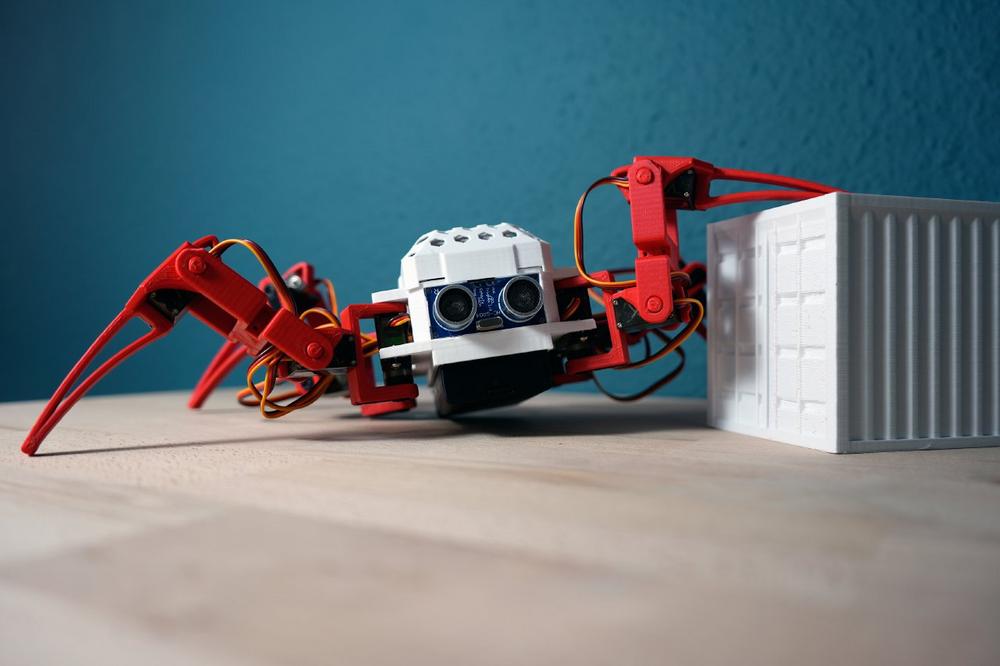
Intuitive robotics via voice control
In industrial practice, controlling robots typically requires specific programming skills and complex input interfaces. Voice-based interfaces represent a promising approach to simplifying access to robotic systems and making their use more flexible. This demonstration shows how spoken language can be used to directly control a robot. The future goal is to enable people with virtually no programming knowledge to instruct robots to perform tasks.
The implementation: from speech to movement
The process centers on natural language processing in several steps. First, spoken instructions are converted into text using Automatic Speech Recognition (ASR). This involves trained models that analyze speech inputs and convert them into written form. This forms the basis for further processing.
A Large Language Model (LLM) then interprets the meaning of the instructions and converts them into structured, machine-readable commands. Put simply, these commands correspond to specific movement instructions that are transmitted to the robot. The process occurs with minimal delay, allowing the robot to respond to the voice input almost in real time.
Obstacle course as an application scenario
The exhibit is designed as an interactive obstacle course. Visitors have the opportunity to control the robot exclusively through voice commands. The task is to guide the robot safely past the obstacles to the finish line as quickly and precisely as possible. This demonstrates that the precision of the voice input is crucial for successful control.
Opportunities for industry
The combination of voice control and robotics opens up new possibilities for human-machine interaction. In areas with frequently changing processes, voice-based interfaces could help reduce the effort required for setup and programming. Additionally, the intuitive controls could enable employees without significant prior knowledge to operate the systems.
From data analysis to AI strategy
The IPH supports companies in making a structured entry into the field of AI. This includes analyzing data potential, identifying application areas, and developing a strategy with a clear roadmap to achieve efficient processes, well-informed decisions, and sustainable added value. Through numerous consulting and research projects, the IPH has demonstrated extensive experience in the field of artificial intelligence.
At the booth, project engineers will provide information on current research and development projects and will be happy to answer questions from industry and academia. Visit the IPH at Hannover Messe 2026 in hall 11, stand B56: https://www.hannovermesse.de/exhibitor/iph-institut-fur-integrierte-produktion/N1605480
The IPH – Institut für Integrierte Produktion Hannover gGmbH (which literally translates into Hannover institute of integrated production) is a service provider for production technology and was established in 1988 at the Leibniz University in Hannover. The IPH offers research and development, consultation and qualification concerning the subjects of process technology, production automation and logistics. Its customers include companies from the sectors of tool and mould construction, machine and plant construction, aerospace and the automotive industry, electro industry and forging industry.
The business has its headquarters in the science and technology park – Science Area 30X in the northwest of Hannover and currently employs about 80 people, of which about 30 are scientific personnel.
IPH – Institut für Integrierte Produktion Hannover gemeinnützige GmbH
Hollerithallee 6
30419 Hannover
Telefon: +49 (511) 27976-0
Telefax: +49 (511) 27976-888
http://www.iph-hannover.de
