Sensitive Conversations with a Patient Language Model
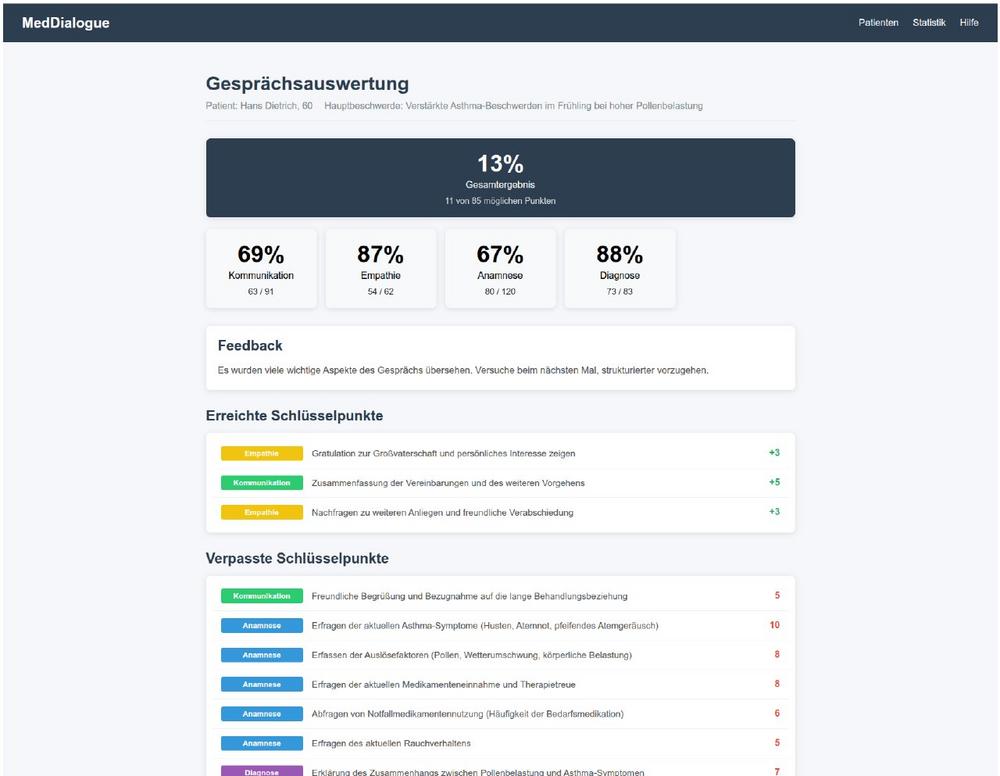
Mr. Dietrich is not a real person, but an avatar. The medical student is actually a computer scientist with a Ph.D., named Dr. Johannes Zink, and is a research assistant at the Chair of Efficient Algorithms of Prof. Stephen Kobourov at TUM Campus Heilbronn. And the conversation took place via the “AI-based Patient Simulation” (KIPS) tool, which Zink is currently helping to develop.
Simulated patient consultations are an important part of medicine studies. They are intended to prepare future doctors to conduct real-life consultations with empathy and effectiveness. Until now, actors have primarily been used for this purpose, taking on the role of patients. The AI-based tool is intended to complement them, but not replace them.
Born Out of a Hackathon
“Actor-patients aren’t always available. They can’t and won’t repeat a conversation as often as needed. An AI tool doesn’t have these drawbacks: It doesn’t get tired of repeating the same content over and over again,” explains Zink. He cites another advantage: “We offer shy or socially anxious people a safe space where they can first try things out and practice the conversation at their own pace.”
KIPS was born at a healthcare hackathon at the University of Würzburg last year. Zink, who had previously studied computer science there, teamed up with a friend—also an alumnus of the University of Würzburg and now a physician at Inselspital Bern—and his colleague. Together, they tackled the challenge set by the Institute for Medical Education and Training Research at the University Hospital of Würzburg (UKW): developing an AI-powered patient conversation simulator.
“We developed a prototype and wanted to expand it further,” reports Zink. “That’s why we applied for funding.” With success: Through the end of the year, KIPS will receive five-figure grants from the “TUM Incentive Fund” at TUM Campus Heilbronn and the Vogel Foundation in Würzburg.
Two Language Models as the Foundation
The technological foundations of the tool are kept quite simple: KIPS consists of two standard language models from OpenAI. One supports spoken input and output, while the other subsequently evaluates the transcribed conversation. The finished tool is intended to be available as a web application in the future.
KIPS is not the first tool to simulate patient consultations using AI. What added value does it offer compared to other platforms? “A unique selling point is the so-called longitudinal approach: We don’t just record individual conversations, but an entire sequence. In this context, a decision made in one conversation can influence the course of the next one.” Another distinctive feature is the involvement of physicians and medical educators from the UKW and Inselspital Bern: “Thanks to them, we offer a high level of expertise. Our colleagues from medical education provide us with cases that are particularly relevant to our purposes.” This distinguishes KIPS from competing products developed with less specialized expertise, for example in the U.S.: “Our tool is tailored to medical education in German-speaking countries and works very well there.”
Also Usable in Other Educational Programs
Will the tool change medical education in the long term? “That’s hard to say,” says Zink. “KIPS initially arose from a wish to expand the opportunities for medical history training in the medical program at the University of Würzburg. But I am confident that it can also be used effectively in other areas in the future and further improve the quality of education.”
And perhaps it will be used not only in medical studies in the future: “It could be adapted for all healthcare professions where conversations or general procedures need to be practiced. The approach would be the same: experts prepare documents with relevant cases, which we implement from a technical perspective using large language models like ChatGPT — so-called LLMs. When someone with specialist expertise is involved, it is certainly easy to adapt the tool and use it in education.”
Die TUM Campus Heilbronn gGmbH
Bildungscampus 2
74076 Heilbronn
Telefon: +49 (0) 7131 264180
Telefax: +49 (7131) 645636-27
https://www.chn.tum.de/de
