Thermography Provides Insights into Cost-Effective Steel Production for Press Hardening
How “Quenching and Partitioning” improves steel properties
To produce low-alloy quenched and tempered steels, the heat-treatment strategy quenching and partitioning (Q&P) is often employed to achieve exceptional combinations of properties. During “quenching,” the material is rapidly and selectively cooled to form a microstructure consisting of martensite and retained austenite. During “partitioning,” the retained austenite is then stabilized by redistributing carbon.
In Q&P steels, costly alloying elements can generally be omitted; only carbon and a sufficient silicon content are required to achieve the desired material properties. The process thus offers enormous potential for the cost-effective production of complex formed parts made from ultra-high-strength steels.
Synchronized measurement of temperature distributions and strain fields
In the experiments, a VarioCAM® HD head 980 infrared camera from InfraTec was used, and its temperature measurement data were combined with digital image correlation (DIC). A trigger box, which connected the infrared camera to the DIC system’s controller, enabled controlled, synchronized recording of the strain fields and temperature distributions throughout the entire experiment at a frame rate of 30 Hz.
These thermographic measurements revealed significant differences between the heating strategies. For example, contact heating was found to have a significantly higher heating rate (>300 K/s) compared to furnace heating, resulting in a shorter heating time and thus potentially higher process productivity.
Thermography as the key to robust Press-hardening processes
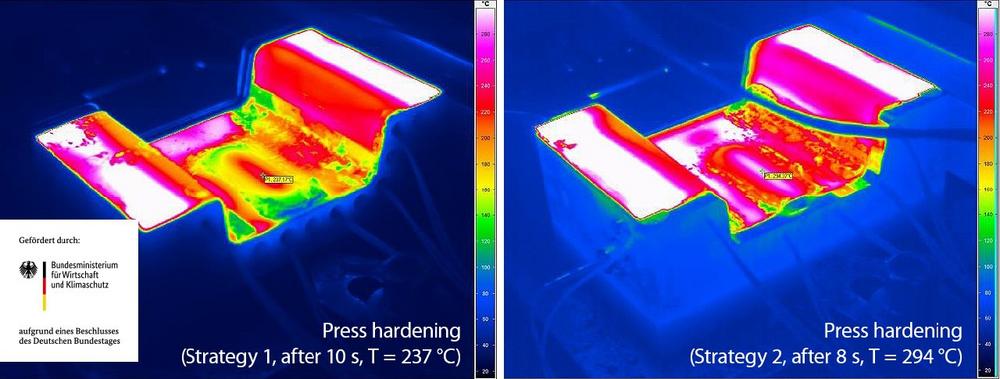
Thermal imaging also played a key role in experiments involving simultaneous forming and quenching, as well as in temperature monitoring during press-based process trials. Using realistic press partitioning strategies, it was demonstrated that the component temperature could be successfully maintained above the martensite finish temperature – a fundamental prerequisite for successful partitioning, i.e., carbon redistribution between different microstructures in the steel.
In addition, the high-resolution thermographic images provided important insights for adjusting the die temperature control and transfer times. Of particular note was the use of thermography in optimizing the thermal process window, which is crucial for achieving the desired microstructure (martensite and retained austenite) and the targeted combination of properties.
Learn more about research projects involving InfraTec:
https://www.infratec.eu/thermography/partner-of-research-and-science/
Learn more about the PRESS-CHECK automation solution:
https://www.infratec.eu/thermography/industrial-automation/press-hardening-press-check/
The InfraTec infrared sensor and measurement technology company was founded in 1991 and has its headquarters in Dresden, Germany. The privately held company employs more than 240 employees and has its own design, manufacturing and distribution capabilities.
With its infrared measurement business unit, InfraTec is one of the leading suppliers of commercial thermal imaging technology. In addition to the high-end camera series ImageIR® and the camera series TarisIR® and VarioCAM® High Definition, InfraTec offers turnkey thermographic automation solutions e. g. for industry processes, non-destructive testing and fire detection and prevention.
The infrared sensor division produces custom-made components – especially pyroelectrical infrared detectors – for clients worldwide. The product range includes analogue single and multi-channel detectors as well as digital multi-channel detectors (PyrIQ). The detectors are used, for example, in gas analysis, fire and flame sensors and spectroscopy.
InfraTec GmbH Infrarotsensorik und Messtechnik
Gostritzer Str. 61 – 63
01217 Dresden
Telefon: +49 (351) 82876-0
Telefax: +49 (351) 82876-543
http://www.infratec.de
