Process Automation in Mechanical Engineering: How Companies Are Removing Manual Routine from Design
What Process Automation Delivers in Engineering
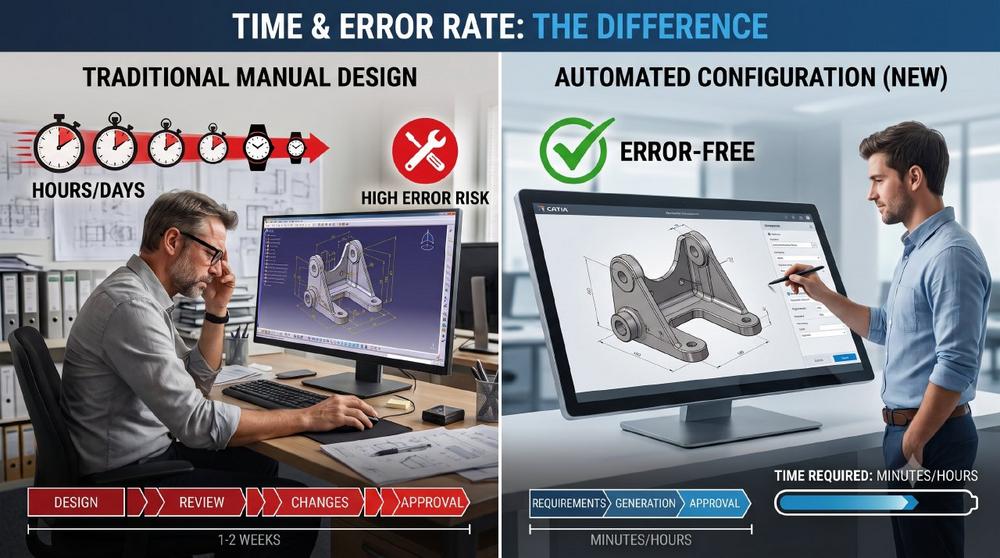
As a key building block of Engineering Automation, process automation connects CAD, PDM, and ERP systems into end-to-end workflows and eliminates existing media breaks. With Lino Automate, recurring tasks – such as opening, editing, and filing technical data – can be mapped rule-based and without programming knowledge using so-called action lists. A trigger, such as a button press or an event in the PDM system, sets off the entire chain: from processing the CAD data to initiating downstream processes in the backend. Lino customers report 25 to 50 percent shorter throughput times and more than 30 percent fewer errors in order processing.
A concrete example is configuration automation with Tacton Design Automation. It is based on a master model in the CAD system, in which all relevant dimensions, components, and features are stored. A configuration model links these attributes to a user interface through which users assemble a variant via input fields, dropdowns, or sliders. A live demo on a hand-operated arbor press illustrated the principle: selecting a higher pressing force automatically adjusts the required dimensions of the press, restricts the choice of spindle diameter, and immediately proposes a valid combination in case of a conflict. Additional parts, such as extra guides, are inserted automatically. At the same time, components – for example the standard base plate – are automatically replaced with an enlarged base plate featuring clamping grooves when needed, without the user having to select individual components. Because every variant is derived from the same error-free master model, technical validity is maintained across all versions.
The production drawing is no longer created manually either: Tacton Design Automation automatically updates dimensions, views, and bill-of-materials positions as soon as the configuration model changes – views don’t overlap, and scales adjust to part size. For SOLIDWORKS users, Lino 2D fix additionally complements drawing automation with its own module. A supplier from the door manufacturing industry puts the time savings from using Design Automation at around 90 percent compared to manually designing comparable variants.
The technical connection is established through interfaces to ERP and PLM systems, so that the generated variant is passed directly into downstream processes. For users, this means they stay within their familiar CAD environment while rules and configuration logic handle the actual automation in the background. Lino GmbH brings nearly 20 years of consulting and software development experience in mechanical engineering to implementing these workflows across different CAD systems such as Autodesk Inventor or SOLIDWORKS.
The time difference is most evident in document creation itself. In the manual process, a design engineer or administrator has to accompany every step individually: opening files, entering part numbers and classifications into the PDM system by hand, checking metadata, creating the document, checking it back in – and doing so anew for every single variant. This time cannot be meaningfully parallelized, because someone effectively has to sit alongside the process and monitor it. With Lino Automate PDM, this bound human factor disappears entirely: the complete workflow runs as a stored action in the background, while the design engineer can already turn to the next task. Minutes per document thus become, in effect, no waiting time at all – not because the individual step runs faster, but because it no longer ties up working time.
Don’t Miss the Webinar
Anyone who wants to see how design processes can be automated with Tacton Design Automation and Lino Automate PDM in Autodesk Inventor will find practical insights in the webinar "Tacton Design Automation with Autodesk® Inventor® and Lino® Automate PDM" on July 30, 2026. The focus is on automating recurring CAD and PDM tasks as well as avoiding change orders through valid design results. Please note: the webinar will be held in English, and no subsequent German translation will be provided.
Die Lino Gruppe ist Anbieter technologieführender Software-Lösungen und von Beratungsleistungen für Design Automation, CAD-Daten-Generierung, CPQ, Systemintegration, 3D-Web-Visualisierung und 3D-Aufstellplanung. Unternehmen verschiedener Industriebranchen realisieren mit Lino Hub, Tacton CPQ, Cosling Configurator oder Tacton Design Automation durchgängige, effiziente Vertriebs- und Produktentstehungsprozesse mit großem Einsparpotenzial.
Lino 3D Konfigurationslösungen setzen neue Maßstäbe in der Produktkonfiguration; sie revolutionieren das Entwerfen, Konfigurieren und Verkaufen komplexer Industrieprodukte. Applikationen aus CAD, PDM, PLM, ERP, CRM, Web, eCommerce oder mobilen Endgeräten lassen sich unkompliziert integrieren.
Konfigurationsspezialist und Softwareentwickler Lino GmbH ist autorisierter Tacton Business Partner, Cosling Partner, SolidWorks Solution Partner, Microsoft Solution Partner und Mitglied im Autodesk Developer Network (ADN). Lino ist an sieben Standorten in Deutschland, Österreich und der Schweiz vertreten.
www.lino.de
www.youtube.com/user/LinoGmbH
www.linkedin.com/company/lino-gmbh
Lino ist ein eingetragenes Warenzeichen der Lino GmbH. Alle anderen Marken und Produktbezeichnungen sind Warenzeichen oder eingetragene Warenzeichen der jeweiligen Rechtsinhaber. © 2026 Lino GmbH
Lino GmbH
Große Bleiche 15
55116 Mainz
Telefon: +49 (6131) 32785-10
Telefax: +49 (6131) 32785-11
https://www.lino.de
