New Global ADS Standards: Arnold NextG Puts the Control Layer at the Center of Future Vehicle Architectures
With the adoption of UN Regulation No. 185 and UN Global Technical Regulation No. 26 for Automated Driving Systems (ADS), the UNECE World Forum for the Harmonization of Vehicle Regulations (WP.29) expanded the international reference framework for automated driving in June 2026 and established harmonized requirements for fully automated driving functions for the first time. It also covers applications in which a vehicle is operated within its Operational Design Domain without continuous human control.
The two instruments complement each other: The UN regulation establishes an approval framework under the 1958 Convention; the UN GTR creates a globally harmonized technical basis under the 1998 Convention, which is transposed into the respective contracting parties’ national or regional systems. This does not result in a globally identical set of registration laws, but rather in a significantly more common technical standard for safety, validation, and verification.
“Autonomy is not resilient simply because an algorithm makes the right decision. It is resilient when the vehicle executes that decision in a controlled manner even under relevant fault conditions,” says Kevin Arnold, CEO of Arnold NextG GmbH. The new ADS regulations do not prescribe a specific architecture. However, they make it clear that safety must be demonstrated across the entire chain of effects and the entire life cycle. That is exactly where our Safety-by-Wire® technology comes into play.”
The new ADS regulations make it clear: The performance of an automated driving system alone is not enough. Only the safe electronic control of steering, braking, and propulsion creates the conditions necessary for autonomous driving decisions to be reliably translated into vehicle movements. Drive-by-Wire thus becomes a central technological foundation for fully automated vehicles.
The safety chain does not end with the AD stack
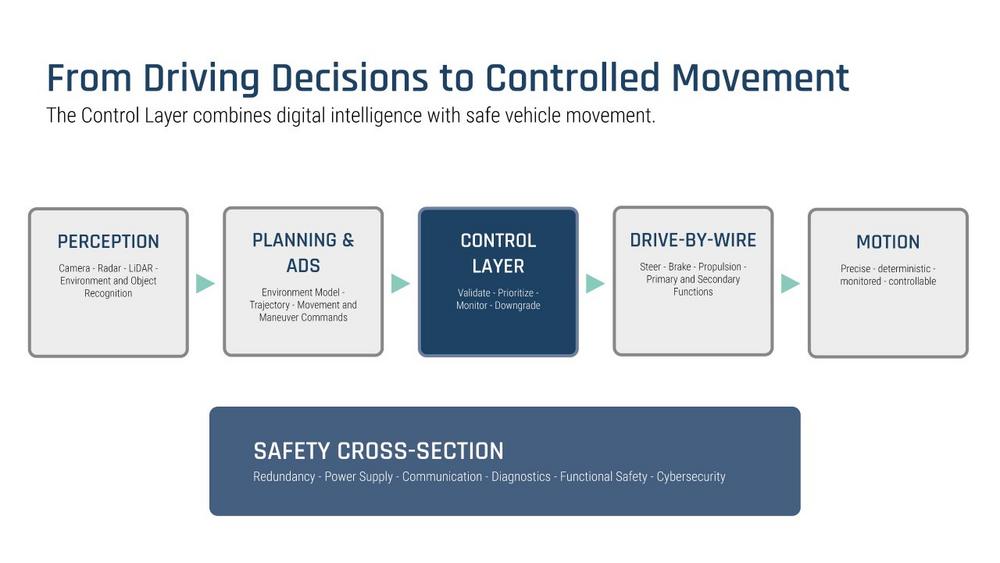
In public discourse, autonomous driving is often described in terms of sensor technology, artificial intelligence, and the performance of the AD stack. However, another layer is crucial for actual vehicle movement: Digital driving decisions must be translated into steering, braking, and propulsion commands, validated, prioritized, monitored, and, in the event of a fault, safely degraded.
Arnold NextG describes this safety-critical level as the Control Layer. The term is not a regulatory requirement but rather an architectural classification: The Control Layer connects the decision-making logic with the actuators and creates a defined, verifiable interface between software and physical systems. It must function independently of whether a driving command originates from an ADS, a teleoperation control center, or driver interaction.
Safety-by-Wire as the Control Layer
With NX NextMotion, Arnold NextG is developing a modular, vehicle-platform-independent, and multi-redundant control platform for drive-by-wire. The quadruply redundant hardware and software architecture is designed to control primary functions such as steering, braking, and propulsion, as well as selected safety-critical secondary functions, on a common system basis and to maintain operation in the event of defined single faults.
According to the company and the TÜV certifications provided, the safety concept is aligned with functional safety standards ISO 26262 up to ASIL D and IEC 61508 SIL 3. Arnold NextG also provides TÜV certifications for steering and braking systems in accordance with UN ECE R79 and R13, as well as road approval for NX NextMotion. This provides a robust foundation for the development, integration, and homologation of autonomous, teleoperated, and software-defined vehicle projects.
The platform’s added value lies not solely in individual by-wire functions. The shared safety architecture is key: it decouples the source of the driving command from its safe execution, reduces interface risks, and facilitates reuse across vehicle variants and applications.
Regulatory Requirements Become Part of the Operating Model
At the 21st session of the UNECE Working Group on Automated Driving Systems (ADS), work continued on the Guidance and Interpretation Documents (GID) for UN R185 and UN GTR No. 26. The session underscored that the new ADS regulations are accompanied by technical guidelines and interpretive aids, and that their practical application is being gradually refined. From Arnold NextG’s perspective, this development underscores that requirements for the safe implementation, monitoring, and verification of automated driving functions— —must be considered across the entire vehicle lifecycle in the future.
For Arnold NextG, this development confirms its own architectural approach: regulatory requirements are not a final chapter to be added after technical development is complete. Requirements for verification, diagnostics, data, software changes, and operational monitoring must be an integral part of system architecture and the product lifecycle from the very beginning.
Under the “Regulatory Insights by Arnold NextG” series, the company will provide technical guidance on the further development of ADS regulations and assess their impact on the control layer, drive-by-wire, functional safety, and homologation.
Technical Sources and Transparency Note
The regulatory statements are based on the published results of the 21st session of the UNECE Working Group on Automated Driving Systems (ADS) as well as the adopted regulations UN R185 and UN GTR No. 26. The classification of the “control layer” and the resulting architectural implications represent the technical position of Arnold NextG. This press release does not constitute legal or homologation-related advice.
About Arnold NextG:
Arnold NextG develops Safety-by-Wire® technology for autonomous, teleoperated, and software-defined vehicles. At its core is NX NextMotion, a multi-redundant, fail-operational central control unit for the safe electronic control of steering, braking, propulsion, and safety-critical secondary functions. The vehicle-platform-independent system architecture forms the control layer of modern vehicle architectures and lays the foundation for autonomous vehicle concepts as well as applications in the areas of remote operation, teleoperation, and platooning. With the road approval of NX NextMotion now complete, a system foundation is available for use on public roads that supports the development and homologation of future drive-by-wire vehicle projects. As an independent advanced development partner, incubator, and system supplier, Arnold NextG supports its customers from the concept phase through homologation. www.arnoldnextg.de
Arnold NextG realizes the safety-by-wire® technology of tomorrow: The multi-redundant central control unit NX NextMotion enables a fail-operational and individual implementation, independent of the vehicle platform and unique worldwide. The system can be used to safely implement autonomous vehicle concepts in accordance with the latest hardware, software and safety standards, as well as remote control, teleoperation or platooning solutions. As an independent pre-developer, incubator and system supplier, Arnold NextG takes care of planning and implementation – from vision to road approval. With the road approval of NX NextMotion, we are setting the global drive-by-wire standard. www.arnoldnextg.com
Über Arnold NextG:
Arnold NextG realisiert die Safety-by-Wire®-Technologie von morgen: das mehrfach redundante Zentralsteuergerät NX NextMotion ermöglicht eine ausfallsichere und individuelle Implementierung, fahrzeugplattform-unabhängig und weltweit einzigartig. Mit dem System können autonome Fahrzeugkonzepte sicher und nach den neuesten Hard- und Software- sowie Sicherheitsstandards umgesetzt werden, ebenso wie Remote-, Teleoperation- oder Platooning- Lösungen Als unabhängiger Vorausentwickler, Inkubator und Systemlieferant übernimmt Arnold NextG die Planung und Umsetzung – von der Vision bis zur Straßenzulassung. Mit der Straßenzulassung von NX NextMotion setzen wir den globalen Drive-by-Wire-Standard. www.arnoldnextg.de
Arnold NextG GmbH
Breite 3
72539 Pfronstetten-Aichelau
Telefon: +49 171 5340377
http://www.arnoldnextg.de
