Industry 4.0
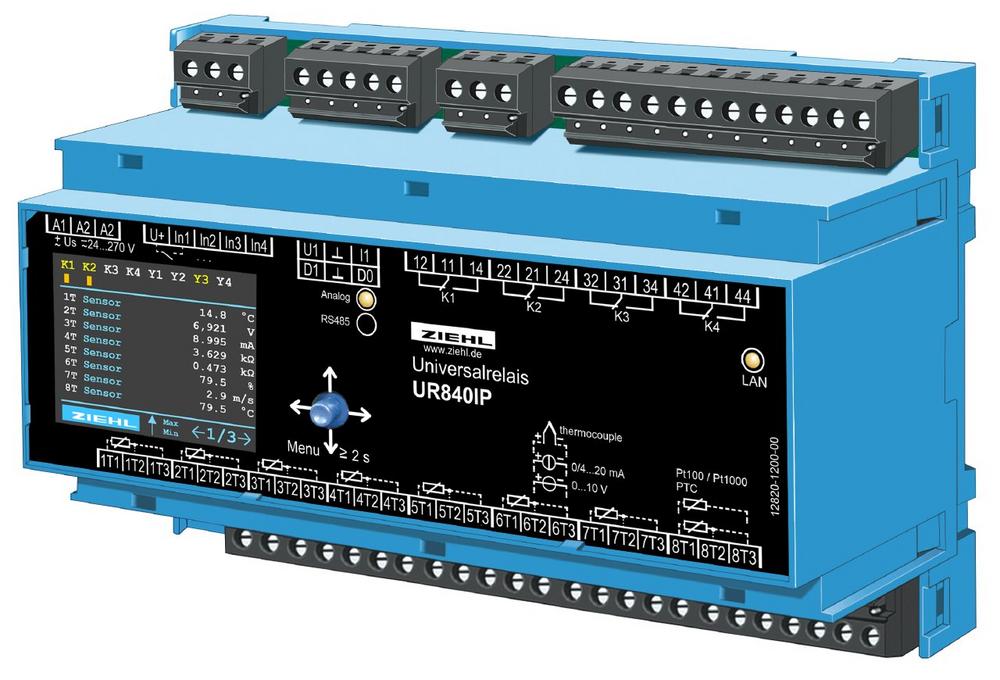
Following the long-established TR250 temperature relay, which has been protecting transformers worldwide against overheating for decades, ZIEHL has introduced the UR series of universal monitoring relays. One of its most versatile members, the UR840IP, is already being deployed in the first transformer substations, where it transforms conventional monitoring into a comprehensive condition monitoring solution.
The UR840IP is a web-enabled universal relay equipped with Ethernet connectivity, making it an ideal platform for implementing holistic condition monitoring in distribution transformer substations. Rather than monitoring only transformer temperatures, it combines multiple process variables, stores operating data, communicates with higher-level control systems, and enables advanced diagnostics based on real operating conditions.
The result is a cost-effective and easy-to-use solution that transforms a conventional transformer substation from an isolated "black box" into a transparent, intelligent component of the modern smart grid.
System Architecture and Sensor Integration
The UR840IP provides eight universal analogue inputs and four digital inputs, allowing a wide range of sensors and status signals to be integrated into a single monitoring platform.
In a typical transformer substation installation, the analogue inputs can be connected to several Pt100 temperature sensors, including:
In addition, humidity and atmospheric pressure sensors can be integrated to monitor environmental conditions. Moisture ingress is one of the major contributors to insulation degradation and premature transformer ageing, making continuous humidity monitoring an important part of predictive maintenance.
The universal analogue inputs also accept standard industrial signals such as 0–10 V and 4–20 mA, enabling easy integration of external transmitters for monitoring:
The four digital inputs provide continuous supervision of critical operating conditions, for example:
Instead of monitoring only transformer temperature, the UR840IP creates a complete operational picture of the entire substation, combining thermal, environmental and operational data into one integrated monitoring system.
Measured Parameters for Comprehensive Condition Monitoring
The true value of condition monitoring lies not only in collecting data, but in understanding the health of the transformer through the interaction of multiple operating parameters. The UR840IP continuously acquires and processes these values, providing operators with meaningful information about asset condition instead of isolated measurements.
One of the most critical parameters is the winding hotspot temperature, as it directly influences insulation ageing and ultimately determines transformer lifetime. According to IEC 60076-7, excessive hotspot temperatures accelerate insulation degradation exponentially. Typical alarm thresholds are around 120 °C, while emergency trip levels are generally configured between 140 °C and 160 °C, depending on transformer design and operating conditions.
In parallel, the top-oil temperature is continuously monitored. Together with the hotspot temperature, it provides valuable insight into transformer loading and thermal behaviour. Long-term trends can also be used to estimate insulation ageing and evaluate the remaining service life of the transformer.
An ambient temperature sensor supplies additional information required to correctly interpret transformer operating conditions. High oil temperatures during extreme summer conditions may represent normal operation, whereas identical temperatures during moderate weather could indicate an emerging cooling problem.
Environmental monitoring is complemented by relative humidity measurement. Moisture is one of the most significant factors affecting insulation performance and transformer lifetime. Continuous humidity monitoring allows operators to detect conditions that may increase the risk of moisture ingress long before permanent damage occurs.
The UR840IP can also integrate signals from current transmitters, pressure sensors and cooling system instrumentation. Parameters such as transformer load, oil pressure, cooling fan status and pump operation provide additional context for assessing transformer health.
The combination of these measurements represents a major advantage over conventional monitoring solutions that focus solely on oil temperature. For example, elevated temperatures at low transformer load may indicate reduced cooling performance rather than excessive electrical loading. Conversely, stable temperatures during periods of high load demonstrate that the cooling system is operating efficiently.
Communication, Data Logging and Remote Access
The UR840IP has been designed for seamless integration into modern digital substations and industrial automation systems.
Its integrated Ethernet interface provides TCP/IP communication and an embedded web server, allowing operators to access live operating data directly from any standard web browser. No dedicated software installation is required. Whether connected through a local network or via secure remote access, maintenance personnel can immediately review operating conditions, parameter settings and historical trends.
For integration into existing automation infrastructures, the relay also provides an RS485 interface with Modbus RTU, while Modbus TCP communication enables straightforward connection to SCADA systems, energy management platforms and central monitoring applications.
Every measured value is recorded together with a precise timestamp using the relay’s integrated real-time clock. Local data logging stores operating data directly inside the device, ensuring that valuable information remains available even if communication with higher-level systems is temporarily interrupted.
For long-term asset management, measurement data can be transferred periodically to a central database. Storing historical operating data over months or years enables utilities and industrial operators to identify gradual changes in transformer behaviour that would otherwise remain unnoticed.
Typical long-term trends include:
These historical trends form the foundation of predictive maintenance strategies and allow maintenance activities to be scheduled based on actual transformer condition rather than fixed inspection intervals.
Intelligent Condition Monitoring and Diagnostics
The UR840IP goes beyond conventional monitoring by combining multiple process variables to generate meaningful diagnostic information.
Using up to eight virtual sensors, the relay can perform calculations such as temperature differences, minimum and maximum values, or other logical relationships between measured parameters. This enables the system to detect operating conditions that cannot be identified from individual measurements alone.
One example is a thermal ageing model, which combines hotspot temperature, oil temperature and ambient temperature. Since transformer insulation ageing increases exponentially with temperature—as defined by IEC 60076-7—the system can estimate cumulative thermal stress and provide valuable information about expected transformer lifetime.
Another application is moisture monitoring. By analysing the relationship between ambient humidity and transformer operating temperatures, operators receive early indications of conditions that may promote moisture ingress and insulation deterioration.
The relay can also monitor the effectiveness of the cooling system. By comparing the temperature difference between transformer oil and ambient air under known loading conditions, the UR840IP can identify reduced cooling performance caused by contaminated cooling surfaces, malfunctioning fans or failing pumps before critical temperatures are reached.
Similarly, sudden increases in winding temperature without a corresponding increase in transformer load may indicate developing internal faults such as winding damage or insulation failures. Early detection allows operators to reduce loading, schedule inspections or prepare replacement activities before an unexpected outage occurs.
Rather than simply generating alarms, the UR840IP supports informed maintenance decisions through intelligent evaluation of multiple operating parameters, helping utilities maximize asset availability while reducing maintenance costs and minimizing the risk of unplanned failures.
Commissioning
Commissioning the UR840IP follows a structured process that ensures reliable operation and seamless integration into the existing automation infrastructure.
After installation, the connected sensors are verified and assigned to the respective analogue and digital inputs. Temperature sensors, humidity transmitters, current transducers and status contacts are checked individually to ensure correct signal acquisition.
The network configuration is then completed by assigning the IP address, subnet mask and gateway according to the customer’s IT infrastructure. Communication is verified through both the integrated web server and
Modbus communication to confirm reliable data exchange with SCADA systems or other supervisory platforms.
A critical commissioning step is the configuration of alarm thresholds and relay outputs. Individual limit values can be assigned to every measured variable. Typical examples include:
Time delays can be configured to prevent nuisance alarms caused by short-term fluctuations. Instead of reacting immediately to temporary peaks, alarm conditions can be validated over a predefined period before triggering an output.
The integrated data logger is then configured with an appropriate recording interval—typically one measurement per minute—providing an excellent balance between storage capacity and trend resolution.
Finally, the real-time clock is synchronized and a complete functional test verifies every sensor input, alarm function and communication channel. The commissioning report documents all parameter settings, ensuring traceability throughout the entire service life of the installation.
Troubleshooting and Practical Diagnostic Examples
One of the greatest advantages of the UR840IP becomes evident during fault diagnosis.
Unlike conventional protection devices that only indicate an alarm condition, the UR840IP provides historical operating data that helps identify the actual root cause.
Example 1 – Cooling System Failure
A transformer suddenly reports an increasing winding temperature. The hotspot temperature rises from 65 °C to 92 °C, while the top-oil temperature remains stable at 72 °C. Transformer loading has not changed. A traditional monitoring system would simply report an overtemperature condition, often resulting in an unnecessary transformer shutdown.
The UR840IP tells a different story.
Historical trend data shows that the winding temperature increased rapidly approximately twenty minutes earlier while transformer load remained constant. At the same time, the digital input monitoring the cooling fan indicates that the fan failed to start.
The diagnosis is straightforward: the transformer itself is operating normally, but the cooling system has failed.
Instead of disconnecting the transformer, operators can temporarily reduce loading while maintenance personnel replace the defective fan or repair the cooling system. This minimizes downtime and avoids unnecessary service interruptions.
Example 2 – Detecting Progressive Transformer Ageing
Historical trend analysis reveals that the top-oil temperature has increased by approximately 5 °C over several months despite identical loading conditions.
Possible causes include:
Without long-term data storage, this gradual deterioration would remain unnoticed until serious problems develop.
The UR840IP enables maintenance to be scheduled before a critical operating condition occurs.
Example 3 – Sensor Validation
After maintenance work, operators observe that only the hotspot temperature has increased while all other temperature sensors continue to report normal values.
By comparing multiple temperature measurements, the UR840IP helps distinguish between an actual transformer fault and a defective sensor.
This significantly reduces unnecessary service interventions and improves diagnostic reliability.
Benefits for Transformer Manufacturers and System Integrators
For transformer manufacturers and switchgear builders, the UR840IP provides an opportunity to deliver significantly more value than conventional monitoring equipment.
Instead of supplying a transformer with basic protection, manufacturers can offer a fully monitored, digitally connected asset ready for predictive maintenance and remote diagnostics.
Key benefits include:
Aggregated operating data collected from installed equipment also provides valuable insights into real-world operating conditions, enabling continuous optimization of future transformer designs.
Benefits for Utilities and Industrial Operators
For utilities, industrial plants and infrastructure operators, the UR840IP supports the transition from preventive maintenance to true condition-based maintenance.
Instead of following fixed inspection intervals, maintenance activities can be planned according to the actual health of each transformer.
Major advantages include:
Continuous condition monitoring also supports regulatory compliance by providing a complete historical record of alarms, operating conditions and system events.
The integrated web server, user management and secure network communication further simplify remote access while supporting modern cybersecurity requirements for critical infrastructure.
Conclusion
The UR840IP demonstrates how modern condition monitoring extends far beyond traditional transformer protection.
By combining multiple sensor inputs, intelligent data processing, integrated data logging and Ethernet communication, the relay transforms conventional transformer substations into intelligent, connected assets within the digital power grid.
For manufacturers, the UR840IP creates opportunities to differentiate their solutions through advanced monitoring and value-added service offerings.
For utilities and industrial operators, it enables predictive maintenance, reduces operating costs and significantly improves system reliability through early fault detection and precise diagnostics.
As electrical infrastructure continues to evolve toward smarter, more connected networks, comprehensive condition monitoring is becoming an essential component of reliable asset management. The UR840IP provides a practical, scalable and cost-effective platform to support this transition while helping operators maximize transformer availability throughout its entire service life.
Innovative, future-oriented and renowned for top quality. Based on the highest technical benchmarks, we develop and produce electronic devices for industrial systems using state-of-the-art technology and a demanding quality management system. We are pioneers in producing electronic devices for modern and reliable measurement, control and regulation technology to meet every requirement – be it in industrial applications, companies, private homes or rented buildings. Goals such as sustainability, energy efficiency and maximum economic efficiency can be ideally achieved using our products. The highest of standards when it comes to commitment for our customers make us the ideal partner for business and industry. Our products are made in Germany. Our operations are certified in accordance with both ISO 9001:2015 and ATEX directive 2014/34/EU and are subject to regular monitoring for UL-approved devices.
ZIEHL industrie-elektronik GmbH + Co KG
Daimlerstraße 13
74523 Schwäbisch Hall
Telefon: +49 791 504-0
http://www.ziehl.de
