Engineering Automation: How Mechanical and Plant Engineers Seamlessly Connect Sales, Engineering, and Manufacturing
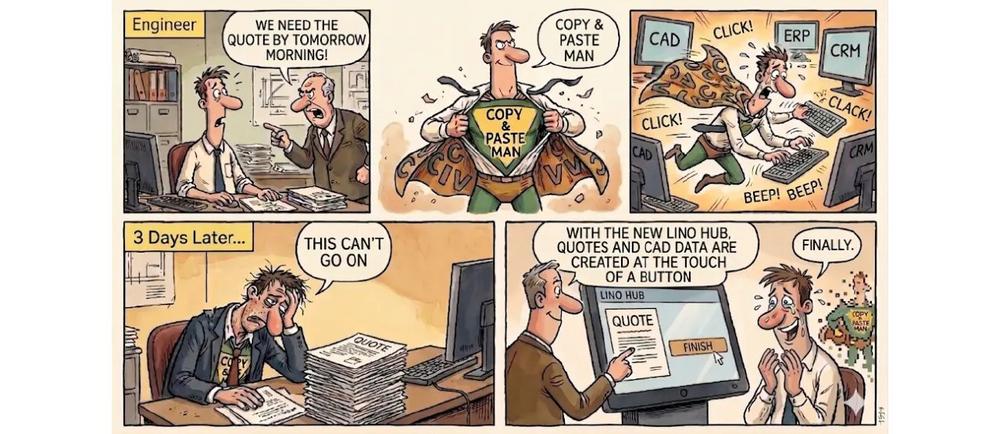
Manual Handoffs Cost More Than Engineering Hours
Organizations in mechanical and plant engineering that deal daily with the same product data being maintained separately across CAD, PDM, ERP, and CRM systems know the consequences: errors that propagate through the entire order processing chain and engineers spending their time on routine tasks rather than advancing product development. According to an internal analysis of Lino customer projects, up to 30% of all errors in typical engineering processes originate from redundant, manual data entries between systems. These errors are not the result of insufficient diligence — they are the result of a process architecture built on manual data transfer.
Engineering Automation addresses this challenge directly: a data-driven automation solution that integrates seamlessly into the existing system architecture and connects four essential automation layers into a continuous process chain.
What Engineering Automation Means in Practice
Engineering Automation refers to the rule-based digitization of technical workflows — from the configuration of highly variable products through automated CAD engineering to the error-free transfer of bills of materials and manufacturing data to ERP and PDM systems. The four layers of this architecture operate in systematic conjunction:
Why Conventional System Integration Falls Short
Measurable Value in Under 30 Days
A common objection to automation projects is implementation time. Lino addresses this concern with a modular approach: standardized software building blocks, proven industry templates, and a clearly scoped proof of concept with a guaranteed outcome enable measurable productivity gains in fewer than 30 days. Scaling to additional use cases and business areas follows in incremental steps.
Key performance indicators measured across completed projects: 25–50% shorter lead times, over 30% fewer engineering errors, 99.9% system availability.
Die Lino Gruppe ist Anbieter technologieführender Software-Lösungen und von Beratungsleistungen für Design Automation, CAD-Daten-Generierung, CPQ, Systemintegration, 3D-Web-Visualisierung und 3D-Aufstellplanung. Unternehmen verschiedener Industriebranchen realisieren mit Lino Hub, Tacton CPQ, Cosling Configurator oder Tacton Design Automation durchgängige, effiziente Vertriebs- und Produktentstehungsprozesse mit großem Einsparpotenzial.
Lino 3D Konfigurationslösungen setzen neue Maßstäbe in der Produktkonfiguration; sie revolutionieren das Entwerfen, Konfigurieren und Verkaufen komplexer Industrieprodukte. Applikationen aus CAD, PDM, PLM, ERP, CRM, Web, eCommerce oder mobilen Endgeräten lassen sich unkompliziert integrieren.
Konfigurationsspezialist und Softwareentwickler Lino GmbH ist autorisierter Tacton Business Partner, Cosling Partner, SolidWorks Solution Partner, Microsoft Solution Partner und Mitglied im Autodesk Developer Network (ADN). Lino ist an sieben Standorten in Deutschland, Österreich und der Schweiz vertreten.
www.lino.de
www.youtube.com/user/LinoGmbH
www.linkedin.com/company/lino-gmbh
Lino ist ein eingetragenes Warenzeichen der Lino GmbH. Alle anderen Marken und Produktbezeichnungen sind Warenzeichen oder eingetragene Warenzeichen der jeweiligen Rechtsinhaber. © 2026 Lino GmbH
Lino GmbH
Große Bleiche 15
55116 Mainz
Telefon: +49 (6131) 32785-10
Telefax: +49 (6131) 32785-11
https://www.lino.de
