In Love with the Office: What Happens When Workspaces Trigger Deep Emotion Instead of Just Function
What does that mean for workspace design? A great deal more than most companies suspect.
Beauty Is Not a Luxury – It’s Neurology
Professor Semir Zeki, neurobiologist at University College London and founder of Neuroaesthetics, has shown in groundbreaking studies that when people experience beauty – whether visual, musical, or spatial – the intensity of that experience correlates with activity in the medial orbitofrontal cortex (mOFC), a key part of the brain’s reward system. The same area that lights up when we fall in love, listen to music that moves us, or feel deep satisfaction.
This isn’t esotericism – it’s functional magnetic resonance imaging, hard data. And the implication for the working world is enormous: Creating beautiful spaces measurably triggers reward responses in employees’ brains – with direct effects on well-being, creativity, and engagement.
Why This Concerns the Office Tower
Research on the impact of workplace design confirms these neurological findings in practice: Workers in well-designed environments not only report higher well-being but also show measurably improved creativity and productivity. Neuroaesthetic studies further reveal that aesthetic elements – color, material, light, proportion – unconsciously influence attention, emotional regulation, and cognitive performance.
The bitter twist: Most office floors in Frankfurt’s skyscrapers or Zurich’s business districts trigger exactly nothing in the brain. No reward. No emotion. No “I want to be here.” They are functionally correct and emotionally invisible.
And yet they are often fitted out at great expense – with the latest systems from two or three leading office furniture brands. High-quality, ergonomic, certified. But ultimately, it’s copy-paste: creations that fail to move, that never spark the neural rush beauty and love share. Interchangeable solutions without a soul.
The Frankfurt Studio as a Neurological Countermodel
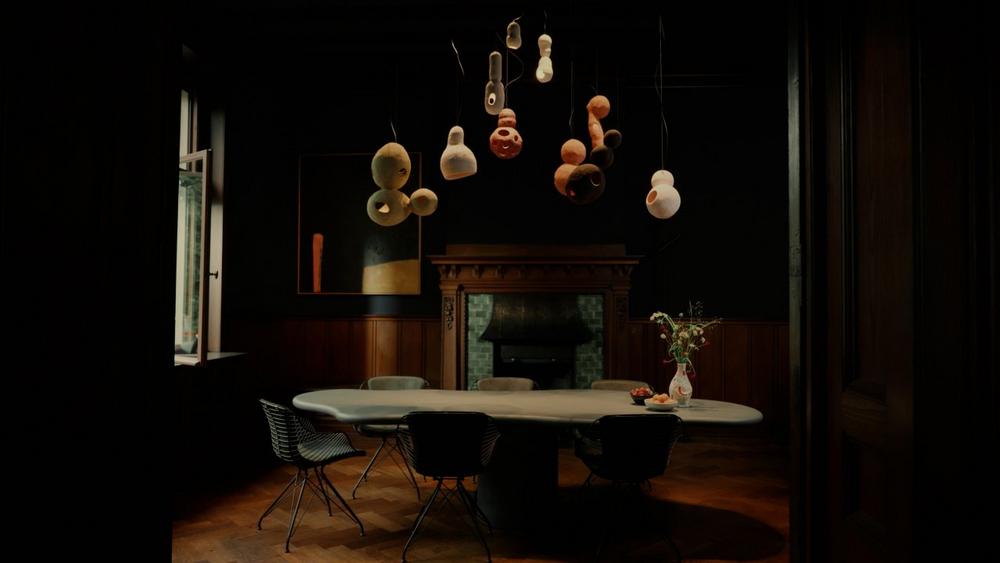
Anna Philipp has turned this insight into a design philosophy. One tangible example is Philipp Architekten’s Frankfurt studio – housed in the historic Villa Passavant in Sachsenhausen – where beauty isn’t treated as decorative garnish but as the architectural starting point.
Every room tells a different story: midnight-blue walls beneath sculptural light objects; nearly four-meter-high stucco ceilings in dialogue with contemporary art; herringbone parquet answering to paneled walls. The result is not a museum, but a workplace that – neurologically speaking – activates the user’s reward system. Employees and visitors alike regularly describe a distinct “energy” in these rooms. What they’re describing is exactly what neuroscience confirms: beauty moves us.
An Investment That Pays Threefold
Those who object that “beauty” is hard to tabulate are right – and still mistaken. The cost of uninspired offices is absolutely measurable: turnover, sick days, declining creative output, recruiting challenges. Companies with high spatial quality report significantly lower turnover and higher employee satisfaction.
Beauty isn’t a marketing expense. It’s an investment in the brains – and thus the creativity and performance – of the people who come in every day.
· Short-term: Employees feel valued and welcome.
· Mid-term: Creativity and team spirit grow in environments that emotionally resonate.
· Long-term: Talents stay – and tell others about it.
The Invitation
You can dismiss all this as “nice to have.” Or you can ask yourself: What if the office were the most powerful expression of a company’s culture – instead of its weakest?
Philipp Architekten take a different path. Not one that begins in a showroom and ends on a floor plan – but one that begins with the question: What should this space do to the people who enter it? The result is architecture and interior design as a finely composed orchestration of materiality, light, atmosphere, and craftsmanship. Spaces where nothing is accidental and everything feels effortless. Spaces you can fall in love with – not because they shout, but because they touch.
“Beauty activates the same regions in the brain as love and infatuation – that’s not poetry, it’s neuroscience. When we design spaces that touch people, we’re not investing in decoration, but in their creativity, health, and sense of connection. That’s the real ROI of good architecture.”
Anna Philipp
Architect BDA SIA
Philipp Architekten BDA is an award-winning architecture and interior design studio led by Anna Philipp, with offices in Frankfurt am Main, Zurich, and Schloss Waldenburg. The practice stands for holistic design where architecture and interior are conceived as one. Guided by the principle ‘Beauty matters’, Philipp Architekten creates sophisticated buildings and soulful workplace environments designed as architectural one-of-a-kind pieces – Collectible Architecture.
Philipp Architekten GmbH
Schlossstrasse 16
74638 Waldenburg
Telefon: +49 791 75990
http://www.philipparchitekten.de
