Arnold NextG Blogspot: When Intelligence Must Act
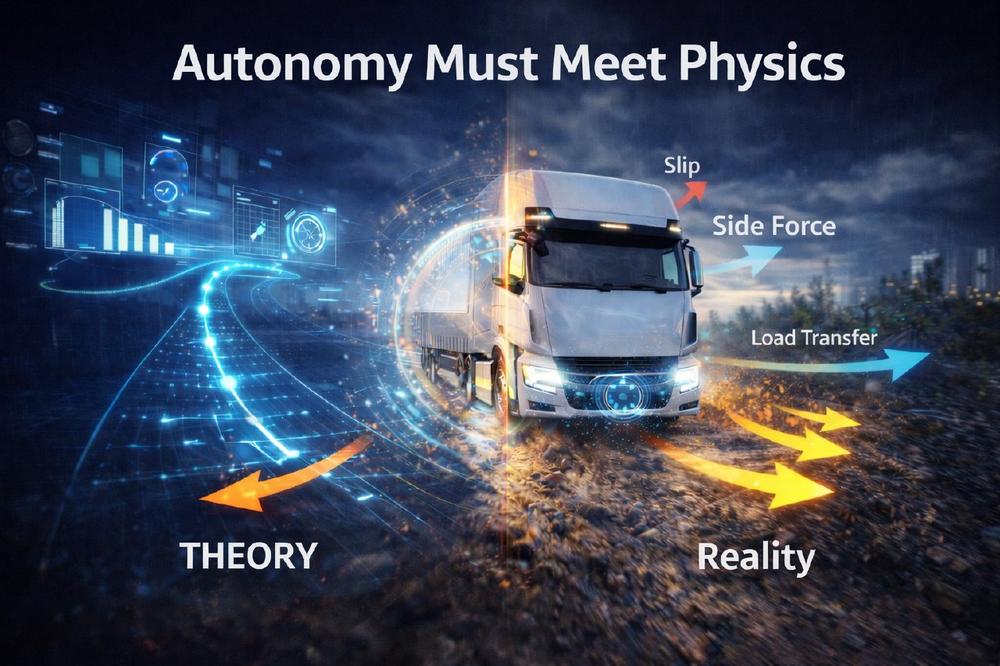
An autonomous vehicle does not operate in digital space, but in the physical world. Decisions only take effect when they are translated into real movement—into steering angles, braking forces, and accelerations. Autonomy therefore does not end with the decision. It begins with the ability to safely implement these decisions under real-world conditions.
From Decision to Physical Reality
Artificial intelligence is inevitably based on models. These models abstract reality: friction coefficients are approximated, dynamics are simplified, and boundary conditions are described statistically. In practice, however, physical effects are immediate—often nonlinear and not fully predictable. A vehicle cannot “approximate” a decision. It must implement it.
This is precisely where the crucial interface of autonomous systems arises: between digital decision-making and physical reality. Normative frameworks such as ISO 26262 on functional safety also make it clear that safety cannot be viewed in isolation at the component level, but must be understood as a property of the overall system.
The term “embodied intelligence” describes precisely this relationship. It is also used in current AI contexts to describe systems whose intelligence is inseparably linked to their physical interaction with the environment (see NVIDIA:). Perception, decision-making, and action form a closed-loop control system.
In the automotive context, this means: An autonomous system must continuously be aware of its own physical capabilities and limitations—not abstractly, but in operation. It must understand how its commands play out under real-world conditions and integrate this feedback directly into its decision-making logic.
Vehicle control as part of intelligence
Drive-by-wire forms precisely this connection. It is the interface where digital decisions translate into physical action—and where physical feedback flows back into the system. Without this feedback, autonomy remains a one-way street: decisions are made, but their physical quality is only evaluated retrospectively . Only through a closed, systemically designed control architecture does vehicle control itself become part of the intelligence.
This also shifts the focus in the development of autonomous systems. A driving stack makes decisions regarding speed, trajectory, and dynamics—but these decisions are only as robust as the understanding of the physical conditions under which they are implemented. Coefficients of friction, limits of adhesion, or emerging instabilities do not arise in the model, but in the interaction between the vehicle and the environment.
A system that does not systematically integrate this feedback inevitably operates with uncertainty. With increasing levels of automation—such as those defined in
SAE J3016 – the human fallback option is also increasingly being eliminated entirely. Vehicle control thus becomes the primary task of the system.
From a thinking system to an acting system
As automation increases, responsibility shifts. It is no longer the driver but the system that bears the consequences of its decisions. In the physical world, there is no debug mode. Errors manifest immediately. What is crucial, therefore, is not maximum decision-making freedom but controlled agency. This capability arises only when intelligence and vehicle control are conceived as a single unit.
Autonomous vehicles mark precisely this transition: from systems that support decisions to systems that act on their own. This step requires more than just powerful AI. It requires an architecture that does not abstract physical reality but integrates it systemically. Regulators are also increasingly addressing this development. Regulations such as UNECE R79 define requirements for electronic steering systems and their behavior under real operating conditions.
Drive-by-wire is not a downstream subsystem here, but the entity that determines whether autonomy works in the real world. Platform approaches such as NX NextMotion from Arnold NextG address this requirement by defining vehicle control as an independent, multi-redundant, and fail-operational overall system—independent of the vehicle platform and designed for real-world operating conditions.
We control what moves
Conclusion
Autonomy does not arise solely from better algorithms. It arises where decisions can be reliably translated into physical reality—in a controlled, predictable, and stable manner, even under constrained conditions. Embodied Intelligence describes precisely this transition: from systems that think to systems that act. Autonomy does not begin with perception. It begins with controlled movement.
Arnold NextG realizes the safety-by-wire® technology of tomorrow: The multi-redundant central control unit NX NextMotion enables a fail-safe and individual implementation, independent of the vehicle platform and unique worldwide. The system can be used to safely implement autonomous vehicle concepts in accordance with the latest hardware, software and safety standards, as well as remote control, teleoperation or platooning solutions. As an independent pre-developer, incubator and system supplier, Arnold NextG takes care of planning and implementation – from vision to road approval. With the road approval of NX NextMotion, we are setting the global drive-by-wire standard. www.arnoldnextg.com
Arnold NextG GmbH
Breite 3
72539 Pfronstetten-Aichelau
Telefon: +49 171 5340377
http://www.arnoldnextg.de
