Arnold NextG Blogspot: The stakeholder map – Who builds, regulates, and operates autonomous mobility
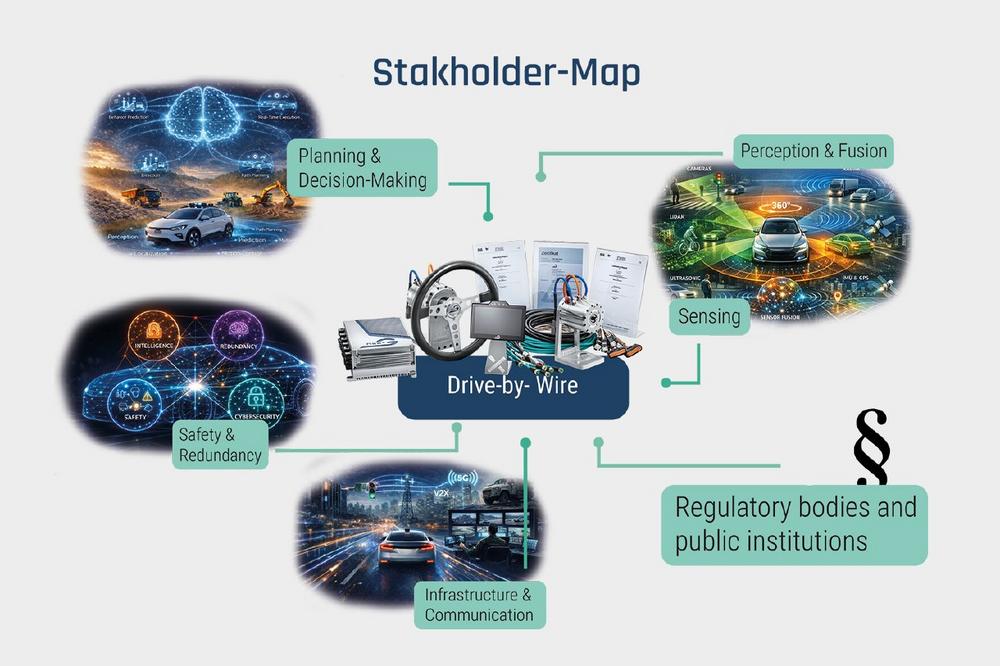
OEMs and Tier 1 suppliers: From vehicle platform to system platform
OEMs continue to bear overall responsibility for the vehicle. But the differentiation is shifting: mechanical performance values are taking a back seat to software compatibility, E/E architecture, and system openness. Tier 1 suppliers are evolving into integration partners for safety-critical subsystems. Braking, steering, and drive systems must not only function, but also be software-defined, certifiable, and remotely controllable.
Arnold NextG is positioning itself in this context as a deep tech Tier 1 supplier for drive-by-wire and motion control. NX NextMotion is integrated at the platform level—as a fail-operational execution layer before an autonomous software stack is activated. This creates a clear separation between decision logic and physical motion execution—an increasingly relevant architectural principle.
Software stack providers: Intelligence with safety certification
The software brain operates on the physical platform. Companies such as Mobileye, NVIDIA, Oxbotica, and Apex.AI are developing modular AD stacks that combine perception, prediction, planning, and decision logic. However, regulatory requirements are increasing as autonomy grows. ISO 26262 defines the functional safety of electrical systems, while UL 4600 is increasingly regarded as the reference framework for safety certification of fully autonomous systems. In addition, cybersecurity requirements such as UNECE R155 and R156 are gaining in importance.
Software providers therefore face a double challenge: Not only do they have to develop intelligent systems, they also have to make their behavior traceable, testable, and certifiable. In this architecture, deterministic, redundant actuators become crucial. Systems such as NX NextMotion take over the standard-compliant implementation of control commands here – regardless of the AI logic used.
Regulatory authorities and standardizers: From control bodies to innovation partners
Regulations are evolving dynamically. With R155 and R156, the UNECE has established binding frameworks for cybersecurity and software updates. ISO 26262 and UL 4600 form the safety-related reference framework.
With its Autonomous Driving Act (2021), Germany has created a basis for Level 4 operation. Since the end of 2025, the Road Traffic Remote Control Ordinance (StVFernLV) has permitted the real-world operation of remote-controlled vehicles under clearly defined technical conditions. Switzerland introduced its own regulations for automated driving in 2025. With the GB17675-2025 standard , China will for the first time regulate fully electronic steer-by-wire systems without a mechanical fallback level.
These developments mark a paradigm shift: the mechanical steering column is no longer a regulatory requirement. Software-defined vehicle control will become eligible for approval in several core markets. Programs such as PEGASUS and ASAM Open Standards support this development with standardized test and scenario models (PEGASUS project; ASAM OpenSCENARIO). Regulators are increasingly acting as test partners rather than mere approval authorities.
Operators and fleet managers: From driver to system manager
The transition to autonomous fleets is shifting responsibility. Operators in public transport, logistics, mining, and defense are becoming system managers. They need control rooms, remote monitoring, software lifecycle management, cybersecurity structures, and event logging. In its position paper on scaling autonomous driving, Bitkom points out that new operating models are needed to integrate autonomous systems economically and organizationally (Bitkom, 2024). Drive-by-wire is becoming a strategic infrastructure component here. Without electronically controllable, redundantly designed steering and braking systems, neither teleoperation nor fleet management is possible.
System integrators: The connecting element
Hardly any one player covers all levels. System integrators connect the vehicle platform, AD stack, control center, communications infrastructure, and certification processes. Arnold NextG works with integrators on such projects to fully embed NX NextMotion into overall architectures—including safety case documentation, cybersecurity integration, and teleoperation interfaces. The role is thus shifting from component supplier to system partner.
Conclusion: Autonomy is cooperative system architecture
Autonomous driving is not a competition between isolated technologies. It is the orchestrated interaction of OEMs, Tier 1 suppliers, software developers, regulators, operators, and integrators. No single player controls the entire ecosystem. But only through coordinated interaction can autonomy become scalable, certifiable, and economically viable. Arnold NextG does not see itself as a visible interface in this architecture, but rather as a supporting layer of motion within safety-critical systems.
We control what moves!
future information: www.arnoldnextg.com/blog
Arnold NextG realizes the safety-by-wire® technology of tomorrow: The multi-redundant central control unit NX NextMotion enables a fail-safe and individual implementation, independent of the vehicle platform and unique worldwide. The system can be used to safely implement autonomous vehicle concepts in accordance with the latest hardware, software and safety standards, as well as remote control, teleoperation or platooning solutions. As an independent pre-developer, incubator and system supplier, Arnold NextG takes care of planning and implementation – from vision to road approval. With the road approval of NX NextMotion, we are setting the global drive-by-wire standard. www.arnoldnextg.com
Arnold NextG GmbH
Breite 3
72539 Pfronstetten-Aichelau
Telefon: +49 171 5340377
http://www.arnoldnextg.de
