The right golf swing with AI
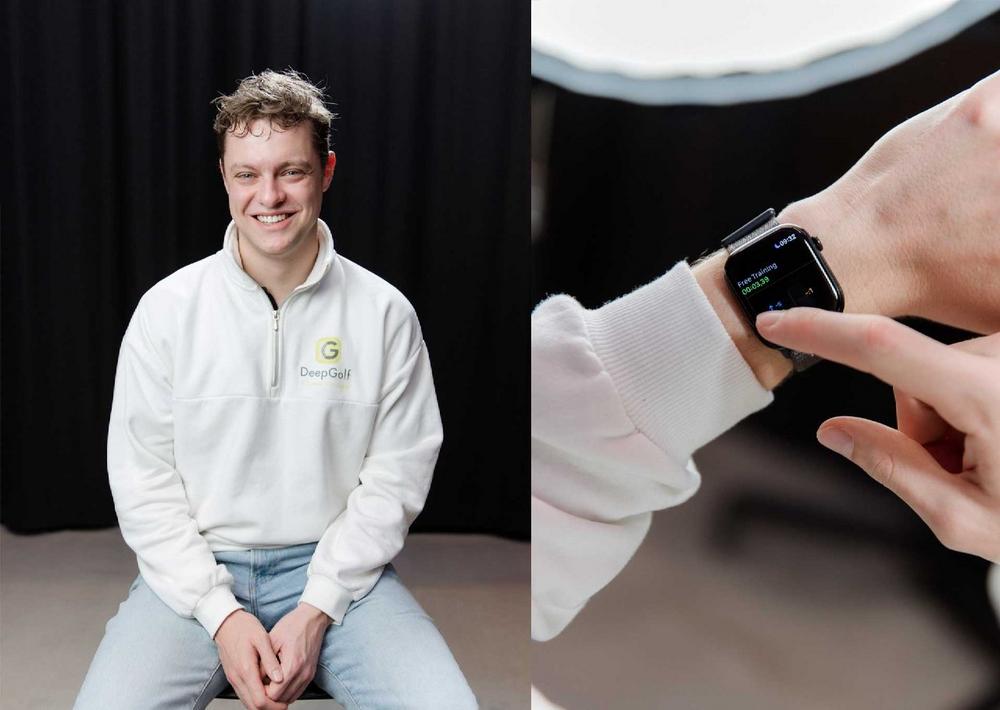
Born in Heilbronn, Jonas developed an interest in crafting, building and creating things at an early age, so after graduating from high school, he decided to study interaction design in Schwäbisch Gmünd: “To gain a deeper understanding into the theory, I then went to TUM for my master’s degree and studied ergonomics and human factors engineering in Munich,” says Jonas. For the young founder, ergonomics involves more than just developing the appropriate office chair: “An important part of it is workplace safety, but also the question of how users can use a product without getting tired.”
What Qigong has in common with golf
Jonas initially had little connection to golf: “Before I started the project, I had no experience of golf and therefore no handicap,” Jonas recalls. The path to the app was paved by a completely different, deeply relaxing discipline: Qigong. “In an interdisciplinary project, we carried out a movement analysis and classification of this Asian form of meditation.” The algorithm was a connecting element. Together with his Master’s thesis supervisor, golf emerged as the next logical application.
At that time, entrepreneurship was still a long way off: “Originally, it wasn’t intended to be a start-up; I was mainly interested in the theory and technical implementation.” It was only after positive feedback from golfers on my master’s thesis that he came up with the idea of developing it further, and “then I started playing golf and familiarizing myself with the training theories and biomechanical processes involved in golf.” Jonas already learned AI skills during his studies at TUM: “In the Human Factors Engineering program, I had a lot of freedom and took very good courses where I learned what AI models are and how they work mathematically.”
The smartwatch as a data provider
Such a model can only work with the right training data, which people collect constantly these days: “The data comes from the smartwatch – every smartphone now has integrated sensors that can detect or record a person’s movements.” That’s why Deep Golf doesn’t require a large setup or cameras, and you can practice your swing away from the golf course in the comfort of your own home. “In the beginning, there were problems with the sensors and how they worked. But we were able to solve that by using an AI algorithm that cleans up this data and finds information in it that shows how to train better or improve your movements,” explains Jonas.
After returning home, Jonas rediscovered Heilbronn and with it the network at the “Bildungscampus”: “It was only after two conversations with TUM Venture Labs that I realized the potential of the Heilbronn ecosystem and that there are support programs available.” He worked on his soft skills with the start-up incubators and received development support from Amr Alanwar, Professor of Cyber-Physical Systems at TUM Campus Heilbronn. “I was allowed to use his sensor system to build a data set, which we then used to train our AI model.”
Planning security thanks to Exist
A collaboration that is now paying off even more, and that is to be taken literally: the Exist funding program supports students or university graduates who want to start a business based on science or economics. With this scholarship, Jonas receives €2,500 per month and an additional €30,000 for the start-up’s material expenses. The prerequisite for this is a mentor. “Since we had already worked together and I was already allowed to use his sensors, it made sense to ask Professor Alanwar, and he agreed.”
This gives the young founder planning security for a year, because there are big tasks ahead: “I had to learn how to present my product in a way that everyone could understand. At pitch events like Slush’D, I only have two minutes to present my entire idea and business model.” It’s a rewarding challenge, because “the core message is crucial for investors.” Jonas quickly realized that he couldn’t do it all on his own: “That’s where my co-founder Marc Mehrer comes in. He takes care of the business side and marketing, while I follow my passion and develop products, including the technical implementation.”
A question of financing
2026 is a crucial year for Deep Golf: “First, we want to determine whether the product can be sold and whether users are willing to pay for it.” After all, Jonas wants to operate profitably in the future and run a healthy start-up. There is also the question of financing the running costs: “Do we need investors, or can we finance it ourselves through bootstrapping?” After a successful tee shot, time will tell if Jonas achieve his golf license with Deep Golf and whether “the student fun project can develop into a sustainable business”.
Die TUM Campus Heilbronn gGmbH
Bildungscampus 2
74076 Heilbronn
Telefon: +49 (0) 7131 264180
Telefax: +49 (7131) 645636-27
https://www.chn.tum.de/de
