Quantum Technology as a Pioneer for Innovation
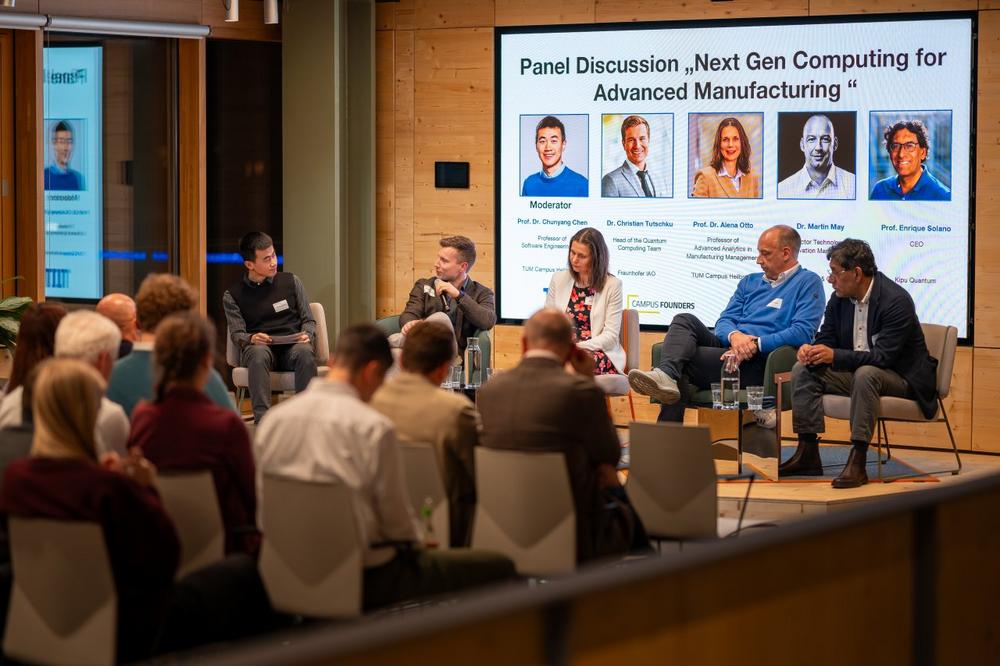
The event kicked off mid-February with a panel discussion in the new Gravity Building of Campus Founders on ”Bildungscampus”. In his introduction, CEO Oliver Hanisch emphasized the mission of the start-up incubators: “We want to turn students into founders and founders into leaders.” TUM Campus Heilbronn was there as a partner and host. The evening was moderated by Chunyang Chen, Professor of Software Engineering & AI at the campus. In his welcoming remarks, Chen set the stage for the upcoming panel discussion on ‘Next-Gen Computing for Advanced Manufacturing (4.0/5.0)’: “Three years ago, there was something that attracted me to move from Australia to TUM Campus Heilbronn. That something was the opportunities.”
Building Trust and Investing Wisely
First, Dr. Christian Tutschku, team leader for quantum computing at Fraunhofer IAO, attempted to answer the almost impossible question of what quanta are. In his opinion, they can be everything at once. Ultimately, however, they are nothing more than a tool. However, before the technology can really take off, questions of reliability and security must be clarified. After all, nothing beats trust in quantum technology – a black box is not an option.
Enrique Solano, CEO of Kipu Quantum, announces a major breakthrough in quantum computing for the coming week. He is an expert in the field: as a researcher, he has published over 500 papers. He describes the transition from academia to the business world as frustrating at first. He is certain that people will eventually use quantum computers without even realizing it. So you won’t need a quantum computer at home. At the moment, too much money is flowing into speculative bubbles, which is hindering real progress.
Getting Small and Medium-sized Businesses on Board
When moderator Chen asked how researchers can promote the introduction of the latest computer technology in practice, Dr. Alena Otto, Professor of Operations & Technology at TUM Campus Heilbronn, offered some possible solutions: “Part of the adaptation process is buying-in users – as they will only accept the technology if they see its benefits and find it easy to use“..” However, this cannot be achieved by researchers alone. “We need to democratize access to computers in general, including next-generation technologies such as quantum computing, especially for small and medium-sized enterprises,” Otto said.
According to Otto, advances in hardware and algorithms are already bringing many benefits today. These include shorter production times, faster research and development cycles, and the use of recycled materials in a profitable and sustainable way. Last but not least, the health risks for employees in manual, highly repetitive jobs are reduced. The professor sees concrete fields of application for quantum technology: “Improved simulation and a better understanding of molecular interactions can significantly shorten research and development cycles for new medicines and vaccines in the coming years. Substantial progress is expected in battery development and materials science, such as the design of novel conductive materials.”
Martin May, Director of Technology & Innovation Management at Schunk, as the voice of regional industry, asks when we will move from development to solution and what tools will be needed to achieve this. May is convinced that effective answers can only be achieved by asking the right questions. Schunk has set itself the goal of involving employees at an early stage and, as with its AI program, empowering them to make use of the innovations. He also sees simulations as a suitable field for quantum computing, provided that the appropriate talent can be recruited.
Put Through Their Paces
This was also the goal of the start-ups from all over Europe, which received advice from experienced mentors on the second CDL day. They received support both in defining their goals and in addressing potential challenges along the way. The young founders‘ ideas were put through their paces in individual and group discussions. Although the ideas in the field of quantum technology remain exclusive, the experts already provided important tips. Visions, storytelling, and a long-term business plan are essential for success. The participating students from TUM Campus Heilbronn learned a lot from the lively discussions.
One of the founders who faced the mentors is Daniel Brunner from the French start-up “Lightspring”. Having grown up in Oedheim near Heilbronn, the event is a return to his home region, from which he benefits: “This is my first time attending CDL in person, and my expectations have been more than exceeded. The individual sessions helped me identify the key issue for our start-up.” Together with his French co-founders, he is developing a product in the field of photonics. Now the direction is set: “In the coming weeks, we will focus on the founding.” At the next CDL in a year’s time, it will be seen which of the teams will become a success story – hopefully all of them.
Die TUM Campus Heilbronn gGmbH
Bildungscampus 2
74076 Heilbronn
Telefon: +49 (0) 7131 264180
Telefax: +49 (7131) 645636-27
https://www.chn.tum.de/de
