Arnold NextG Blogspot: Software as the brain – How autonomous vehicles plan and make decisions
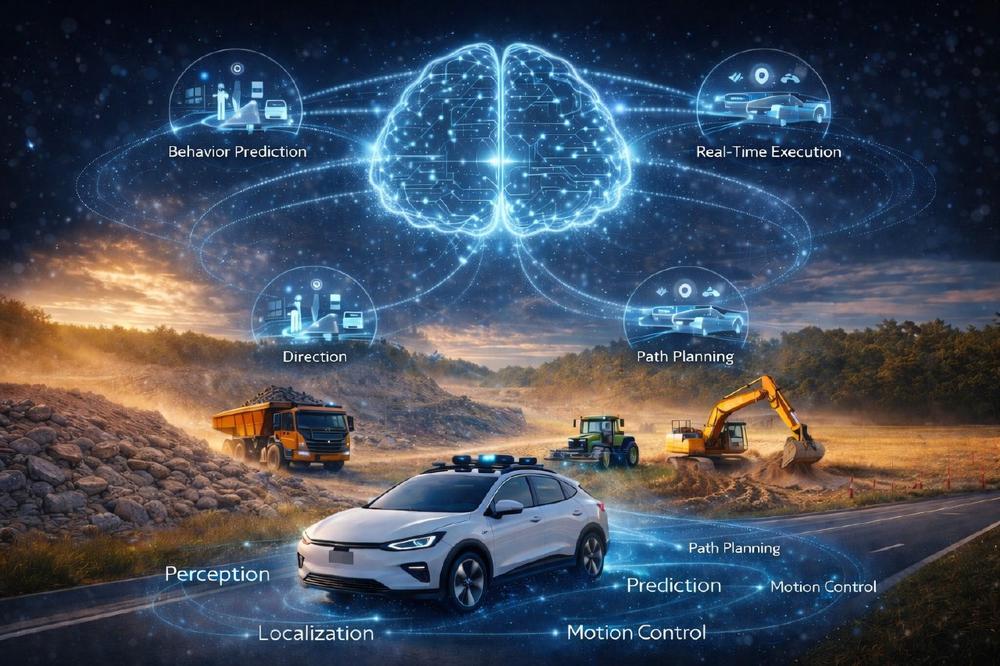
Each control cycle involves a complex chain of events: the environment is scanned, objects are classified, and the vehicle’s own location is determined. The system then predicts the behavior of other road users, calculates a safe path, and implements it immediately via drive-by-wire. This process is repeated every ten to 50 milliseconds – faster than the blink of an eye.
As Prof. J. Christian Gerdes from the Center for Automotive Research at Stanford University emphasizes: "Driving is not just about recognizing – it’s about reacting. In autonomy, the delay between input and action can mean the difference between safety and accident."
Software stack: Think in layers, act redundantly
A modern autonomous system consists of modular software components, each of which fulfills a specific function – and together enable dynamic overall behavior. These include:
This modular architecture allows adaptation to a wide variety of vehicle types and applications. Leading providers such as Mobileye, NVIDIA, and Oxbotica rely on flexible software stacks with certified hardware integration – similar to Arnold NextG, where NX NextMotion is designed as a motion layer specifically for use in safety-critical decision-making architectures. Standardized interfaces (including ASAM OpenX) allow the system to be connected directly to prediction, path planning, and teleoperation backends.
Decision architecture: Fail-operational is a must
In fields such as defense, port logistics, construction, or mining, failures are not an option – neither at the sensor level nor at the decision-making level. In the event of a fault, systems must not only shut down, but also respond in a controlled and traceable manner.
This is exactly what NX NextMotion is designed for: The platform has four separate control paths with independent decision-making logic, double-secured power supply, and selectively controllable actuators. In combination with safety-oriented watchdog monitoring and built-in status diagnostics, it meets the requirements of ISO 26262, ISO 61508, UNECE R155, and UL 4600 – including the provision of forensically readable black box logging.
Application determines architecture: adaptive intelligence instead of standard solutions
Whether geofencing in public transport, dynamic path adaptation in logistics, or ethically regulated systems in defense applications – every autonomous vehicle has different requirements in terms of the depth and redundancy of its decision-making logic.
NX NextMotion offers an application-open motion layer that reacts deterministically to planning decisions at the system level. In agriculture, it enables robust implementation of pre-planned paths in difficult terrain; in military platforms, it allows a clean separation between decision and execution – even in the event of temporary radio loss or external teleoperation.
Transparency as a technical criterion: Approval requires traceability
Simulation, validation, and auditability are not additional functions, but core requirements of modern autonomy development. Regulators demand scenario coverage (e.g., through PEGASUS or ASAM OpenSCENARIO), explainable decision models, and documented system histories.
NX NextMotion delivers this traceability through an integrated control protocol system that records control pulses, state changes, and reactions in real time. This provides developers, testing agencies, and OEMs with a reliable data basis – both for approval and for continuous safety monitoring during operation.
Conclusion: Autonomy requires reliable execution – and clear system responsibility
Autonomous systems must not only make "smart" decisions – they must also implement these decisions safely and transparently. NX NextMotion was developed at Arnold NextG precisely for this purpose: as a motion-oriented execution layer that can be seamlessly integrated into certified decision-making architectures – fail-operational, modular, and audit-proof.
We control what moves!
Über Arnold NextG:
Arnold NextG realisiert die Safety-by-Wire®-Technologie von morgen: das mehrfach redundante Zentralsteuergerät NX NextMotion ermöglicht eine ausfallsichere und individuelle Implementierung, fahrzeugplattform-unabhängig und weltweit einzigartig. Mit dem System können autonome Fahrzeugkonzepte sicher und nach den neuesten Hard- und Software- sowie Sicherheitsstandards umgesetzt werden, ebenso wie Remote-, Teleoperation- oder Platooning- Lösungen Als unabhängiger Vorausentwickler, Inkubator und Systemlieferant übernimmt Arnold NextG die Planung und Umsetzung – von der Vision bis zur Straßenzulassung. Mit der Straßenzulassung von NX NextMotion setzen wir den globalen Drive-by-Wire-Standard. www.arnoldnextg.de
About Arnold NextG:
Arnold NextG realizes the safety-by-wire® technology of tomorrow: The multi-redundant central control unit NX NextMotion enables a fail-safe and individual implementation, independent of the vehicle platform and unique worldwide. The system can be used to safely implement autonomous vehicle concepts in accordance with the latest hardware, software and safety standards, as well as remote control, teleoperation or platooning solutions. As an independent pre-developer, incubator and system supplier, Arnold NextG takes care of planning and implementation – from vision to road approval. With the road approval of NX NextMotion, we are setting the global drive-by-wire standard. www.arnoldnextg.com
Arnold NextG GmbH
Breite 3
72539 Pfronstetten-Aichelau
Telefon: +49 171 5340377
http://www.arnoldnextg.de
