Arnold NextG Blogspot: Autonomous Mobility in Extreme Scenarios – When Technology Must Guarantee Safety
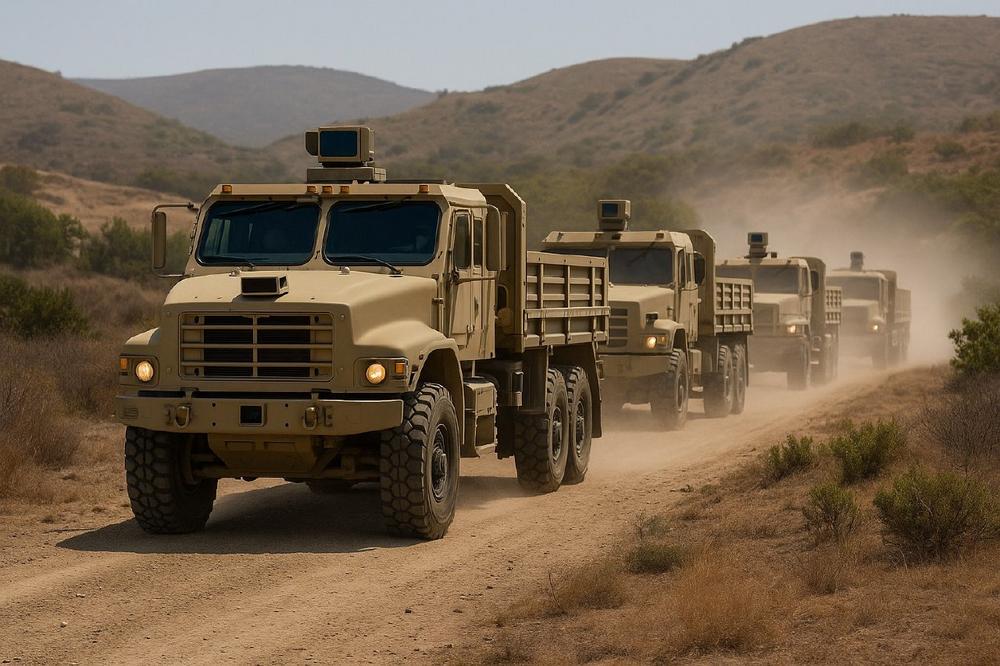
In this context, the term “dual use” describes the transferability of advanced civilian technologies into military or security‑relevant domains. Technologies that have already proven themselves in logistics, mining, or agriculture are being systematically adapted for armored platforms, tactical supply vehicles, or robotic reconnaissance systems. At the center of these applications is always a control architecture that remains functional even under maximum load – such as Drive‑by‑Wire. Without mechanical coupling, but with defined redundancy, secure autonomous control, or teleoperation, it provides the basis for scalable mobility in uncertain environments.
A look back
The U.S. Department of Defense initiated early field trials of autonomous logistics convoys under the “Leader‑Follower” program, in which only the lead vehicle was manned while all following vehicles operated in automated mode. In Europe, studies and projects followed on the use of autonomous systems in civilian disaster relief and military support missions. Since 2022, these efforts have intensified – driven not least by geopolitical shifts, new threat scenarios, and the funding agenda of the European Defence Agency (EDA).
Status quo (2025)
Across Europe, autonomous mobility is increasingly classified as strategically critical infrastructure. Beyond classic defense use cases, this includes broader societal resilience – for example in energy supply, response to natural disasters, or cyber defense. Manufacturers such as Rheinmetall, Iveco Defence, and Milrem Robotics are developing operational solutions ranging from unmanned resupply vehicles to semi‑autonomous rescue platforms. Countries such as Israel and Australia have also established specialized test fields for unmanned ground vehicles, focusing on interoperability, modularity, and protection levels.
A report by the European Court of Auditors identifies dual‑use mobility solutions as a security‑policy priority field (ECA 2025). Market analyses, including those by Mind the Bridge, likewise position autonomous ground platforms as a critical element of future European security architectures. The decisive bottleneck remains the technically and regulatorily robust interface between civilian innovation and military integration.
Technology transfer into practice
A platform such as NX NextMotion – originally developed for use in agricultural, logistics, and specialized vehicles – demonstrates how mature civilian systems can be transferred into security‑relevant contexts. What matters here is not only core functional capability, but also certifiability, modularity, and resilience under operational load. The system is fully electric, shock‑resistant, remotely controllable via standardized protocols, and meets the highest requirements for functional safety (ISO 26262 ASIL D).
Outlook to 2030
Experts expect a significant increase in autonomous vehicles in safety‑critical environments by the end of the decade – particularly for tactical logistics, reconnaissance, and crisis supply. A scalable, standardized base remains a prerequisite. This is exactly what the EDA is currently working on together with standardization bodies: defining European standards for dual‑use mobility platforms – interoperable, auditable, and mission‑ready.
Why Arnold NextG is relevant here
Arnold NextG does not develop weapons platforms – but it does provide the vehicle‑side infrastructure that makes the decisive difference in real operations. NX NextMotion is modular, IP69K‑certified, cybersecure, and designed for extreme environments. It can be integrated into armored or unmanned vehicles, including secure teleoperation interfaces, redundant control logic, and software‑based system diagnostics. Systems like this not only enable operational safety – they define it.
We control what moves.
Arnold NextG realizes the safety-by-wire® technology of tomorrow: The multi-redundant central control unit NX NextMotion enables a fail-safe and individual implementation, independent of the vehicle platform and unique worldwide. The system can be used to safely implement autonomous vehicle concepts in accordance with the latest hardware, software and safety standards, as well as remote control, teleoperation or platooning solutions. As an independent pre-developer, incubator and system supplier, Arnold NextG takes care of planning and implementation – from vision to road approval. With the road approval of NX NextMotion, we are setting the global drive-by-wire standard. www.arnoldnextg.com
Arnold NextG GmbH
Breite 3
72539 Pfronstetten-Aichelau
Telefon: +49 171 5340377
http://www.arnoldnextg.de
